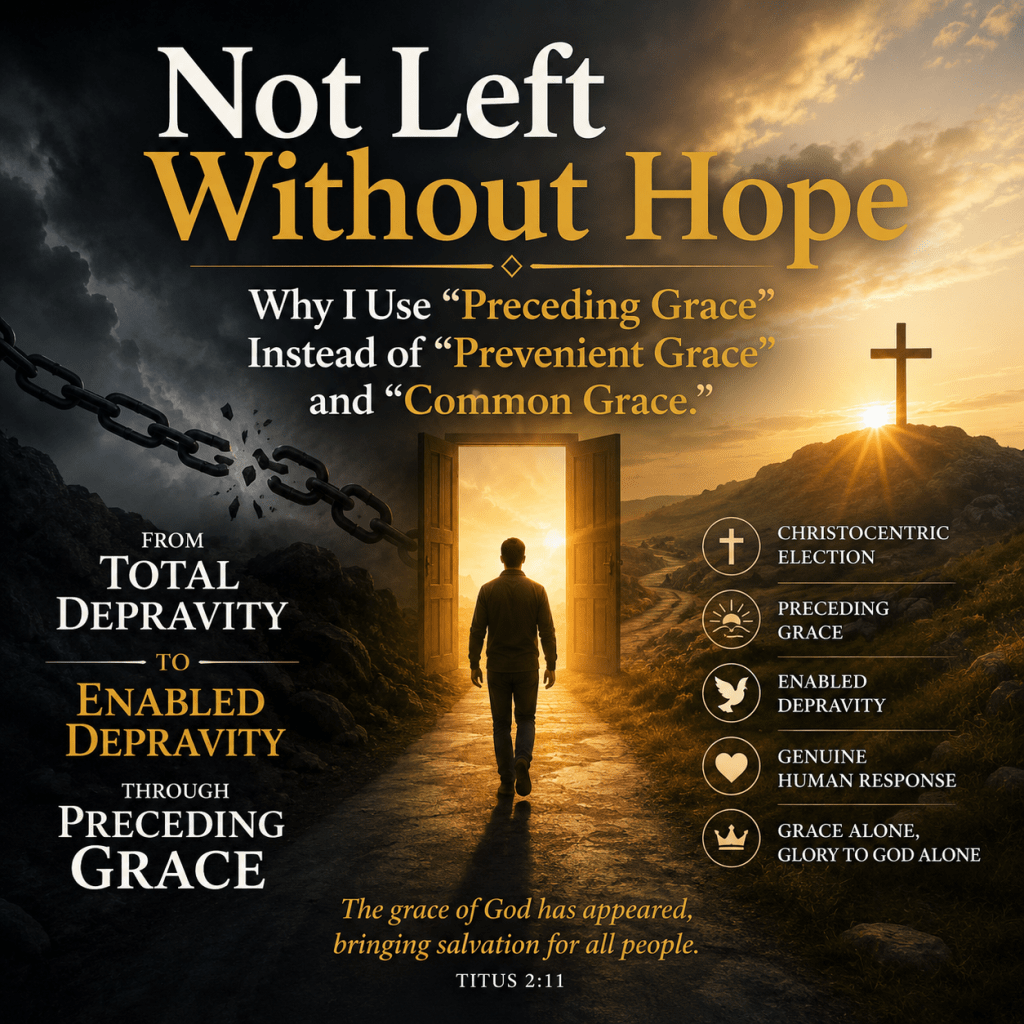
I use the term Preceding Grace because words shape doctrine, and doctrine shapes devotion. When I speak about the Grace that comes before repentance and faith, I want the emphasis to fall on God’s action, not on human autonomy. Jesus says, “No one can come to me unless the Father who sent me draws him,” and yet He also says, “when I am lifted up from the earth, I will draw all people to myself” (John 6:44; 12:32, ESV). For me, those two texts already tell the story: Grace is prior, Grace is Christ-centered, and Grace is not a reward for the sinner’s first movement.
I do not reject the historical concern behind the older term ‘prevenient grace’. In fact, the Christian tradition has long confessed that Grace comes first. Augustine argues that there is “no merit in men’s choice of Christ” unless God’s Grace was already there before that choosing. Aquinas later explains that Grace is called prevenient because it causes earlier effects in us before later ones. John Wesley, in turn, speaks of “preventing grace,” the older English way of saying Grace that goes before. So my preference for Preceding Grace is not a rejection of history. It is an attempt at pastoral clarity.
“God’s grace was prevenient in His choosing them.”
Reference: Augustine, On Grace and Free Will, ch. 38, AD 426/427.
The reason I do not simply keep the term prevenient Grace is that, in many modern ears, it sounds as if Grace merely restores to man a decisive, self-determining freedom that finally makes the sinner the ultimate cause of coming to Christ. Yet I do not believe fallen man comes to Christ by autonomous free will. I appreciate the historic insistence that Grace comes first. I do not affirm that the sinner, once “enabled,” becomes an independent spiritual first cause. Even within Wesleyan usage, prevenient Grace is often described as enabling those who will respond, and Wesley himself famously speaks of a “measure of free-will” restored by Grace. My concern is that many readers hear that language and interpret it as autonomy. I want a term that keeps their eyes on divine initiative.
At the same time, I want to say something else clearly: the Calvinist doctrine of Total Depravity is not wrong if we are speaking about what fallen human nature is in itself. Paul says, “None is righteous, no, not one,” “no one seeks for God,” and “all have sinned and fall short of the glory of God” (Rom. 3:10–12, 23, ESV). He says we were “dead in the trespasses and sins” (Eph. 2:1, ESV). Jesus says the sinner is “a slave to sin” (John 8:34, ESV), and Paul adds that the mind set on the flesh “does not submit to God’s law; indeed, it cannot,” and that those in the flesh “cannot please God” (Rom. 8:7–8, ESV). That is why I am fully willing to say that Total Depravity is ontologically true of fallen humanity.
But that is not the end of the matter. My claim is that Preceding Grace modifies the condition of fallen humanity from hypothetical Total Depravity to actual Enabled Depravity. Why do I say that? Because Scripture also says that Christ is “the true light, which gives light to everyone” (John 1:9, ESV); that when He is lifted up He will “draw all people” to Himself (John 12:32, ESV); that “the grace of God has appeared, bringing salvation for all people” (Titus 2:11, ESV); that God “desires all people to be saved and to come to the knowledge of the truth” (1 Tim. 2:4, ESV); that the Spirit will “convict the world” (John 16:8, ESV); and that God’s kindness is “meant to lead” sinners “to repentance” (Rom. 2:4, ESV). These texts do not teach that all are saved. They do teach that fallen humanity is not left in a bare state of unaddressed ruin. Humanity is met, confronted, illumined, drawn, and convicted by God.
This is why I use the term ” Enabled Depravity.” Humanity remains depraved. Humanity does not become neutral. Humanity does not become naturally free. Humanity does not become spiritually autonomous. But because of God’s prior Grace in Christ, humanity is no longer merely considered in abstraction as if humanity existed outside the reach of divine drawing. In other words, while humanity is fallen and incapable of saving itself, we should not describe humanity as though God has left humanity entirely to its fallen condition. Because Christ has entered history and extends “Preceding Grace,” or the Grace that preceded it, humanity now exists under a real divine drawing that enables a genuine response to the gospel. In that sense, Total Depravity is hypothetical in present experience. It tells the truth about what fallen nature is apart from Grace; yet because Preceding Grace is already operative in the world, the actual condition of humanity is better described, in this framework, as Enabled Depravity.
John Wesley comes surprisingly close to this point when he says there is no man now in a “state of mere nature.” That statement is extremely important for me. It means we should not describe the present human condition as if God had left the race wholly untouched after the fall. The sinner remains ruined in Adam, yes. But the sinner also stands beneath the prior activity of Christ’s light, Christ’s drawing, God’s kindness, and the Spirit’s conviction. Enabled Depravity, therefore, is not a denial of ruin. It is a description of ruined humanity under preceding Grace.
“There is no man that is in a state of mere nature.”
Reference: John Wesley, On Working Out Our Own Salvation, Sermon 85, Sept.–Oct. 1785.
This also explains why I reject libertarian free will. By that phrase, I mean the idea that the decisive power of contrary choice finally lies in the autonomous self. I do not believe Scripture teaches that. Jesus says no one can come unless drawn (John 6:44). Lydia believed because “the Lord opened her heart” (Acts 16:14, ESV). Paul says, “because of him you are in Christ Jesus” (1 Cor. 1:30, ESV), and Ephesians says salvation is “not your own doing” (Eph. 2:8, ESV). Yet Scripture also says, “you always resist the Holy Spirit” (Acts 7:51, ESV). So the response of man is real, but it is never autonomous. The sinner does not come to Christ by self-originated freedom; he comes because God precedes him with Grace and enables his response without ceasing to be God.
At this point, I need to distinguish Preceding Grace from Calvinistic Common Grace. I do not deny the truth that Reformed theology is trying to protect there. Scripture plainly teaches that God “makes his sun rise on the evil and on the good” (Matt. 5:45, ESV), and that He gives “rains from heaven and fruitful seasons,” filling human hearts “with food and gladness” (Acts 14:17, ESV). Reformed writers rightly use the term “common Grace” for God’s universal providential goodness, restraint of evil, and preservation of a fallen world. Kuyper’s great contribution was to insist that the world is not less sinful because man is less corrupt, but because God curbs the outworking of sin.
“He curbs the operations of Satan, death, and sin.”
Reference: Abraham Kuyper, Principles of Sacred Theology, as quoted in The Goodness of God and Common Grace; Kuyper (1837–1920).
But my point is that Preceding Grace is not exhausted by that category. Common Grace, in Reformed usage, represents non-saving favor and restraint. Preceding Grace, as I use it, points to a more explicitly Christological and redemptive direction: illumination, drawing, conviction, witness, and gracious enablement toward repentance and faith. Herman Bavinck is helpful here because he links Christ the Logos, common witness, and the broader theater in which Grace addresses humanity. That does not mean Bavinck meant CLARE by that language. It does mean the path is not unnatural.
“he enlightens every human coming into the world.”
Reference: Herman Bavinck, Reformed Dogmatics, vol. 4, ch. 1; cited excerpt from Monergism; Bavinck (1854–1921).
This is also where I introduce the CLARE distinction between the Eternal Elect and the Preceding Elect. This distinction flows directly from Christocentric Election, Enabled Depravity, and Preceding Grace.
By the Eternal Elect, I mean those spoken of in Ephesians 1:4, where God “chose us in him before the foundation of the world” (ESV). I also hear that note in John 6:37, where Jesus says, “All that the Father gives me will come to me” (ESV). This is Election in its eternal and divine origin. These are those whom God chose in Christ before creation and whom He irresistibly brings to saving faith according to His eternal purpose.
The Eternal Elect are therefore not merely invited to Christ; they are effectually and infallibly brought into union with Him. Their salvation rests upon God’s eternal decree and cannot ultimately fail because God Himself ensures their coming.
But CLARE Theology does not stop there.
Classical Calvinism often divides humanity into two ultimate groups: the Elect and the Reprobate. The Elect are irresistibly brought to salvation. The Reprobate remain in Total Depravity and therefore cannot positively respond to God because they are never given saving Grace. In that framework, those who are not eternally elected possess no genuine hope of salvation.
CLARE Theology takes a different approach.
While affirming Eternal Election, CLARE rejects the conclusion that all who are not Eternally Elect are therefore hopelessly reprobate. Christ’s atonement was sufficient for the entire world. God’s Preceding Grace extends universally. Christ is the true light who “gives light to everyone” (John 1:9, ESV). He draws “all people” to Himself (John 12:32, ESV). The Grace of God has appeared “bringing salvation for all people” (Titus 2:11, ESV). The Spirit convicts “the world” (John 16:8, ESV).
For this reason, humanity is not divided between the Eternally Elect and the hopelessly abandoned. Humanity exists under Enabled Depravity.
This means that while fallen humanity remains incapable of saving itself, God has not left humanity in a condition where response to Him is impossible. Christ’s atonement and God’s Preceding Grace modify the lived condition of fallen humanity from hypothetical Total Depravity to actual Enabled Depravity.
The sinner remains ruined.
The sinner remains dependent.
The sinner remains incapable of self-salvation.
Yet the sinner is not abandoned.
The sinner is illumined, confronted, convicted, drawn, and enabled through God’s gracious action in Christ.
This is where the doctrine of the Preceding Elect emerges.
By the Preceding Elect, I do not mean people who make themselves elect through autonomous free will. Nor do I mean that sinners independently choose God apart from Grace. Rather, I mean those who, though not chosen as individuals in Eternal Election, are nevertheless enabled by God’s Preceding Grace through Christ’s sufficient atonement and, within the condition of Enabled Depravity, come to repentance and faith, thereby becoming elect through union with Christ, the Elect One.
The Preceding Elect become Elect because they become united to Christ.
Their Election is not grounded in autonomous willing.
Their Election is not grounded in self-generated faith.
Their Election is not grounded in personal merit.
Their Election is grounded in Christ.
Paul repeatedly speaks this way.
“Because of him you are in Christ Jesus” (1 Cor. 1:30, ESV).
Believers are sons of God “through faith” in Christ Jesus and become Abraham’s offspring because they belong to Christ (Gal. 3:26–29, ESV).
Likewise, Paul speaks of salvation occurring “through sanctification by the Spirit and belief in the truth” and through God’s call in the gospel (2 Thess. 2:13–14, ESV).
The pattern is significant.
God acts first.
Grace precedes.
The Spirit convicts.
Christ draws.
The gospel calls.
Faith responds.
Union with Christ follows.
Election is realized in Christ.
The Preceding Elect therefore do not become Elect because they possessed libertarian free will. They become Elect because God’s Grace made their response possible.
At this point, an analogy may be helpful.
Imagine two men trapped in a burning building.
The first is carried out by a firefighter who determined beforehand that he would certainly rescue him. The firefighter reaches him, lifts him from the flames, and ensures his rescue. This resembles the Eternal Elect.
The second man is also reached by the firefighter. He is awakened from sleep. He is shown the path of escape. He is repeatedly urged to follow. He does not extinguish the fire. He does not create the exit. He does not rescue himself. Every possibility of survival depends entirely upon the firefighter’s intervention. Yet he may either follow the rescuer or resist the rescue. If he follows, his salvation remains entirely dependent upon the rescuer’s action. This resembles the Preceding Elect.
In both cases, the rescuer receives the glory.
In neither case does the victim save himself.
Or consider another analogy.
Imagine a dark room.
Eternal Election is like a blind man’s eyes being infallibly opened so that he certainly sees the light.
Preceding Grace is like the light entering the room itself. The light makes sight possible. Those who see do so because of the light. They did not create vision. They did not create illumination. The light came first.
Some look toward the light.
Others shut their eyes against it.
Yet in both cases, sight was possible only because light entered the room.
Likewise, salvation is only possible because Christ first enters the darkness of the human condition.
This distinction allows me to preserve what I believe Scripture preserves.
Election is never severed from Christ.
Election is never grounded in autonomous human willing.
Election is never reduced to philosophical determinism.
The Eternal Elect speaks of God’s eternal purpose in Christ.
The Preceding Elect speaks of the historical and redemptive way God’s Grace reaches persons through illumination, conviction, drawing, and enablement.
Both categories find their meaning in Christ.
The Eternal Elect are chosen in Christ from eternity and irresistibly brought into union with Him.
The Preceding Elect become Elect through union with Christ by means of God’s Preceding Grace operating within Enabled Depravity.
In both cases, Christ is the ground of Election, Grace is the cause of salvation, and boasting is excluded.
Here, I also find early Christian witnesses helpful.
Justin Martyr speaks of the Logos as present among humanity, and Irenaeus describes salvation through the incarnate Word as humanity’s entry into adoption. Those voices do not erase important doctrinal differences across the centuries. Still, they reinforce an important instinct: the story of salvation begins with God’s prior movement toward us in His Word and Son, not with the sinner’s autonomous decision.
“The seed of reason [the Logos] implanted in every race of men.”
Reference: Justin Martyr, Second Apology, ch. 8; Justin Martyr (c. 100–c. 165).
Recommended Reading
Augustine, On Grace and Free Will — still one of the clearest early Christian statements that Grace does not destroy will, yet precedes and enables all good willing.
Thomas Aquinas, Summa Theologiae, I–II, q. 109 and q. 111 — essential for the classical distinction between Grace as inward divine help, and for the formal language of prevenient and subsequent Grace.
John Wesley, “On Working Out Our Own Salvation” — crucial for the older English language of “preventing grace,” for the denial of bare natural ability, and for the claim that no one now exists in a merely natural condition untouched by Grace.
Abraham Kuyper, Common Grace: God’s Gifts for a Fallen World, vol. 1 — useful not because it says the same thing as CLARE, but because it gives the strongest Reformed account of Grace as restraint and preservation, which your article needs to distinguish from Preceding Grace.
Herman Bavinck, Reformed Dogmatics, vol. 4, ch. 1 — especially valuable for connecting Christ as Logos, divine witness in creation and history, and the broader theater in which the gospel call appears.


