Blog

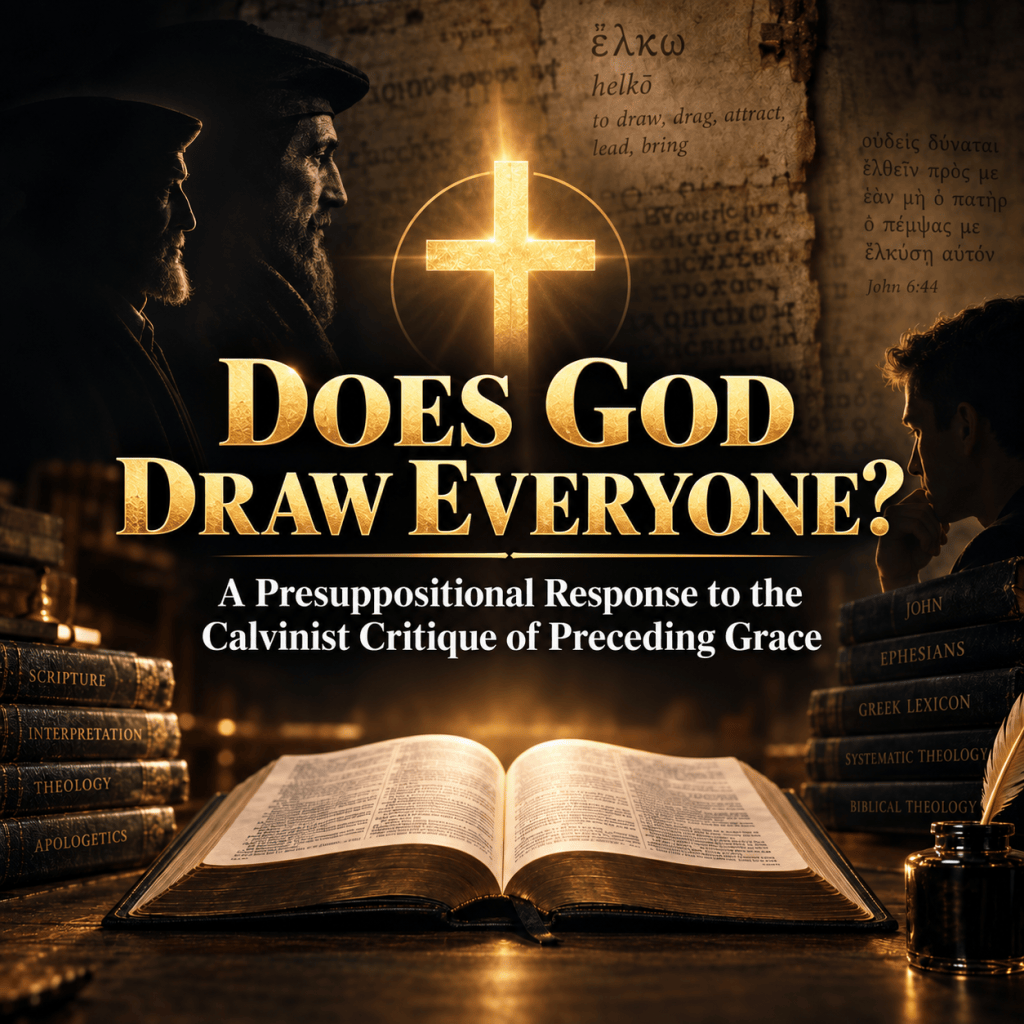
  • Does God Draw Everyone?

    A Presuppositional Response to the Calvinist Critique of Preceding Grace

    John 6:44, John 12:32, Preceding Grace, Enabled Depravity, and Christocentric Election

    ————————————————————————————

    Thank you for raising a substantive objection. Before addressing John 6:44, John 12:32, Ephesians 2, and human response, I think we need to identify several presuppositions already at work in your argument. Everyone

    You are not approaching these passages from a theological vacuum. Neither am I. The question is therefore not whose interpretation has presuppositions, but which presuppositions best account for the entire biblical witness.

    The Presuppositions Driving the Critique

    Your argument appears to assume the following:

    1. If God draws salvifically, that drawing must always be irresistible.

    2. All grace related to salvation must have the same effectual or regenerative function.

    3. “Dead in sin” must be interpreted with all the properties of a literal corpse.

    4. If God gives grace that can be resisted, God’s purpose has failed.

    5. If human faith is not irresistibly caused, it must therefore be autonomous, meritorious cooperation.

    6. Election can refer only to individuals eternally selected before creation, leaving no Christocentric mode of election through subsequent union with Christ.

    Those are precisely the assumptions CLARE Theology disputes. If they are simply built into the argument, Calvinism wins before the texts are actually examined.

    1. Does helkō Mean “Compel by Irresistible Force”?

    You wrote that the Greek ἕλκω / ἑλκύω (helkō/helkyō) literally means “to compel by irresistible force.” That is too strong lexically.

    LSJ gives the basic range as “draw, drag,” but also includes metaphorical uses such as drawing to oneself or attracting. Abbott-Smith distinguishes physical dragging from metaphorical “draw, lead, impel.” Thayer likewise distinguishes physical dragging from metaphorical drawing by inward influence. In these lexicons, John 6:44 and John 12:32 are treated as metaphorical uses, not as proof that the lexical meaning itself is “irresistible grace.”

    Therefore, pointing to Paul being physically dragged in Acts 16:19 or a fishing net being hauled in John 21:11 does not prove that every metaphorical use of the same verb carries the same degree and mode of force.

    The same word does not imply an identical mode of force in every context. Context determines the force of the metaphor.

    2. CLARE Can Affirm Effectual Drawing in John 6:44

    “No one can come to me unless the Father who sent me draws him, and I will raise him up on the last day.” — John 6:44

    CLARE Theology need not deny that John 6:44 describes an effectual drawing. In fact, CLARE can understand this passage as the Father’s effectual drawing of the Eternal Elect.

    The Eternal Elect may resist Preceding Grace for a time, but God’s ultimate saving purpose toward them cannot fail. They will come. CLARE calls this Irresistible Saving Grace.

    The disagreement is not whether John 6:44 can be effectual. The disagreement is whether every gracious divine drawing mentioned elsewhere must therefore have the same soteriological function.

    That conclusion does not come from the lexical meaning of helkō itself. It comes from a prior theological system.

    3. What About John 12:32?

    You make a legitimate contextual observation: Greeks approach Jesus in John 12:20, so some interpreters understand the “all” in John 12:32 as emphasizing Jews and Gentiles. That interpretation deserves consideration.

    “And I, when I am lifted up from the earth, will draw all to myself.” — John 12:32

    But there are two important qualifications. First, the Greek does not literally say “all peoples.” John uses πάντας (pantas), the accusative masculine plural of πᾶς (pas), meaning “all.” “People” is supplied in English. The phrase “all kinds of people” is therefore an interpretation of scope, not the lexical wording itself.

    Second, CLARE Theology does not require John 12:32 to bear the entire doctrine of universal Preceding Grace. Even if, for argument’s sake, the Jew/Gentile interpretation were granted, other passages still have to be accounted for:

    • John 1:9 — Christ gives light to everyone.

    • John 16:8 — the Spirit convicts the world.

    • Titus 2:11 — the grace of God appears bringing salvation to all people.

    • Romans 2:4 — God’s kindness leads toward repentance.

    • Romans 1:19 — God has made knowledge of Himself plain.

    Preceding Grace rests on a cumulative biblical pattern of divine initiative rather than on a single interpretation of John 12:32.

    4. The Critique Conflates Preceding Grace with Regenerating Grace

    The objection claims that CLARE creates a grace that “attempts to save but fails.” But that assumes something CLARE explicitly denies: Preceding Grace and Irresistible Saving Grace are not the same operation with different success rates.

    Preceding GraceIrresistible Saving Grace
    Reveals, illuminates, draws, convicts, confronts, and enables genuine response.Infallibly accomplishes God’s saving purpose toward the Eternal Elect.

    Therefore, saying Preceding Grace can be resisted does not mean, “God attempted regeneration and the sinner defeated Him.” God was not attempting irresistible regeneration in that operation.

    The Calvinistic presupposition here is that if grace has any relationship to salvation, its purpose must always be infallible regeneration. But Scripture can describe real divine activity toward sinners without implying that every such activity infallibly regenerates them.

    Acts 7:51 speaks of resisting the Holy Spirit. Romans 2:4 speaks of God’s kindness leading to repentance. Jesus speaks of people being unwilling to come.

    If God sovereignly intends an operation to permit resistance, resistance does not defeat omnipotence. God accomplishes exactly what He intended that operation to accomplish.

    5. Ephesians 2 and the “Corpse” Argument

    “A corpse cannot be partially un-neutralized to decide whether it wants to be resurrected.” — objection summarized

    The analogy is rhetorically vivid, but it imports characteristics of a literal biological corpse into Paul’s metaphor that Paul himself does not include.

    In Ephesians 2, the spiritually dead are simultaneously walking according to the world, following the prince of the power of the air, living in the passions of the flesh, and carrying out desires. These “dead” people are active. Therefore, spiritual death cannot simply mean physical non-functionality in every respect.

    CLARE agrees that spiritual death includes alienation from God, bondage to sin, condemnation, and inability to generate spiritual life from oneself. CLARE also agrees that God makes us alive. The sinner does not regenerate himself.

    But this is exactly where the critic must understand two CLARE doctrines before assessing Preceding Grace: Hypothetical Total Depravity and Anthropology of Enabled Depravity.

    Hypothetical Total Depravity

    Hypothetical Total Depravity describes humanity considered apart from every gracious initiative of God. In such a condition, no sinner could produce saving faith, seek God independently, or rescue himself. Humanity would be spiritually dead and entirely unable apart from grace.

    Anthropology of Enabled Depravity

    Enabled Depravity describes humanity’s actual lived condition under God’s already-present gracious activity. The sinner remains fallen, sinful, unregenerate, dependent, and incapable of saving himself, yet the sinner is not untouched by God.

    • Christ illuminates.

    • The Spirit convicts.

    • God reveals.

    • The Gospel calls.

    • Grace precedes.

    CLARE does not teach a “half-resurrected corpse.” Preceding Grace is not regeneration. Regeneration remains God’s act.

    6. “If One Believes and Another Does Not, Man Becomes the Decisive Cause”

    This is probably the strongest objection. The question is: if two sinners receive Preceding Grace and one believes while the other resists, what distinguishes them?

    First, CLARE does not teach that every individual receives a mathematically identical quantity of grace under identical providential circumstances. Universal does not mean mechanically identical. People receive different amounts of revelation, Gospel exposure, conviction, providential circumstances, knowledge, and opportunities.

    But even if the hypothetical is granted, two people under equally sufficient Preceding Grace, the conclusion still does not follow unless another presupposition is added: if the response is genuinely human, it must be autonomous and meritorious.

    “To the one who does not work but believes…” Romans 4:5

    Paul himself distinguishes belief from meritorious works. CLARE therefore distinguishes between condition, instrument, and cause. Faith is the condition or instrument by which Christ is received. Faith is not the efficient cause of salvation.

    The sinner did not provide the incarnation, Christ’s righteousness, the cross, the atonement, Preceding Grace, divine revelation, justification, regeneration, preservation, or glorification.

    The sinner provides a response to salvation, not a contribution to salvation.

    A critic may define monergism so narrowly that anything short of God’s causal determination of the very act of believing counts as synergism. But then the argument becomes circular: “Calvinistic monergism is true because I define salvation so that only Calvinistic monergism qualifies.”

    CLARE’s claim is narrower and more precise: God alone is the efficient saving cause. The human being genuinely responds beneath and because of prior grace. A genuine response is not the same as a co-redemptive contribution.

    7. The Critique Is Not Presupposing Christocentric Election

    The objection also assumes that “the elect” can mean only those individuals eternally selected before creation. CLARE affirms those people and calls them the Eternal Elect. But CLARE’s doctrine of election begins even more fundamentally with Christ Himself as the Elect One.

    Ephesians 1 repeatedly locates salvation “in Christ,” “in Him,” “in whom we have redemption,” and “in Him…you heard the gospel…and believed.” Therefore, election is not treated as an abstract decree detached from Christ but as fundamentally Christocentric.

    Eternal ElectPreceding Elect
    Elected in Christ before creation and therefore certainly brought to Him.Come to Christ under God’s already-present Preceding Grace and, through union with the Elect One, become elect in Him.

    John 6:37 itself contains two statements that CLARE refuses to weaken:

    “All that the Father gives me will come to me…”

    “…and whoever comes to me I will never cast out.”

    The first clause affirms the certainty of the Eternal Elect. The second affirms the certainty of Christ’s reception of the one who comes. The critic assumes that the second clause can describe only the identical group already mentioned in the first. CLARE asks whether that identification must be assumed rather than demonstrated.

    The Fundamental Presuppositional Disagreement

    The disagreement is therefore deeper than helkō.

    Presuppositions of the CritiqueCLARE Framework
    One mode of election.Christocentric Election with two modes of election.
    One effectual mode of salvific grace.Resistible Preceding Grace and Irresistible Saving Grace.
    Spiritual death read through literal corpse inability.Hypothetical Total Depravity and Enabled Depravity.
    Genuine resistibility treated as divine failure.God sovereignly ordaining genuinely resistible gracious operations.
    Human response treated as autonomous unless irresistibly caused.Grace-enabled human response without co-redemptive contribution.

    That does not automatically prove CLARE correct. It means CLARE cannot be refuted merely by assuming Calvinism’s categories and then observing that CLARE does not fit them.

    The question both sides must answer is: Which framework allows the greatest amount of Scripture to speak in its own context without forcing one class of texts to erase another?

    That is the Claridian Method: Scripture first. Christ at the center. System underneath Scripture — even CLARE Theology.

    Lexical References

    • Liddell-Scott-Jones (LSJ), entry for ἕλκω

    • Abbott-Smith Greek Lexicon, entry for ἕλκω

    • Thayer Greek Lexicon, Strong’s 1670 (helkō)

    • Interlinear text of John 12:32

    DGMA Doctrine – Christ Over Everything

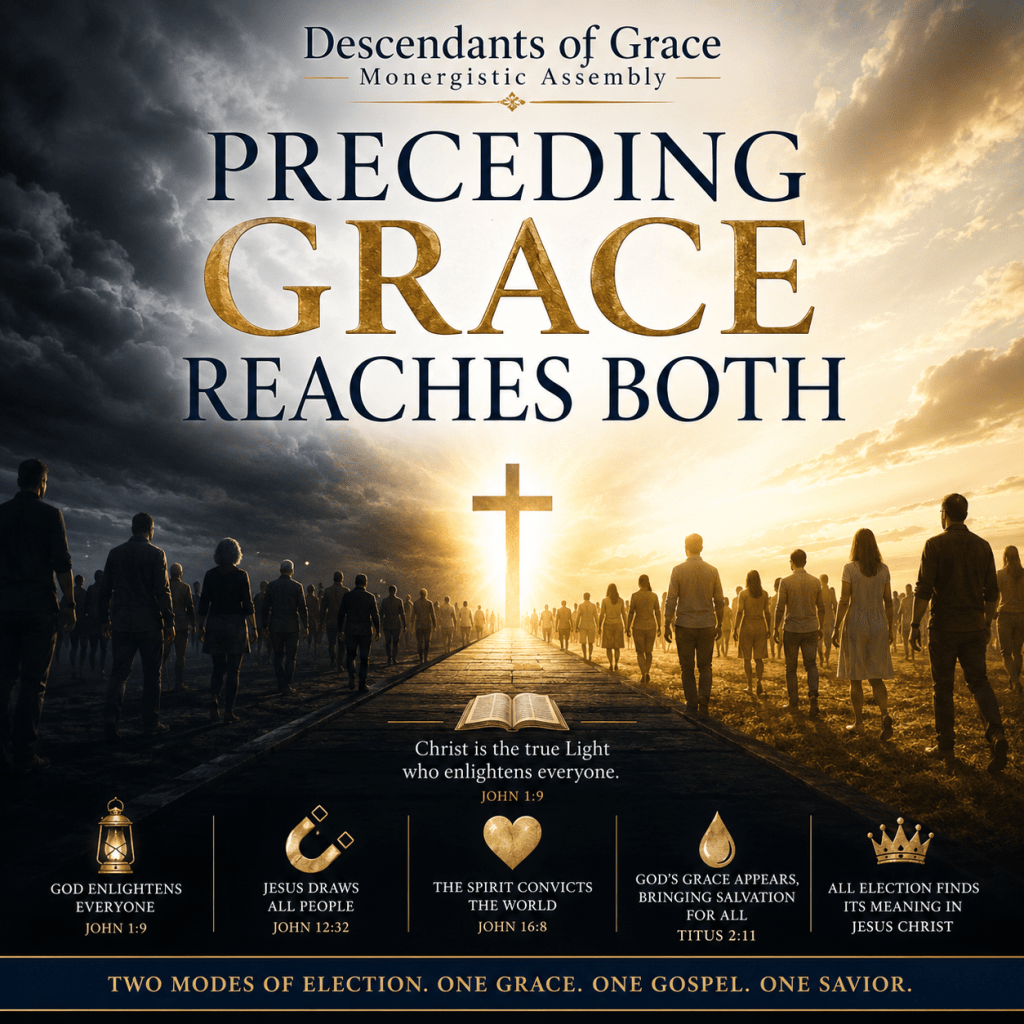
  • Preceding Grace Reaches Both: Two Modes of Election

    CLARE Theology does not teach that Preceding Grace belongs only to the Preceding Elect. Rather, Preceding Grace is God’s universal gracious activity toward fallen humanity, extending to both the Eternal Elect and the non-Eternal Elect. Before anyone seeks God, God has already acted.

    Scripture repeatedly speaks of this gracious activity in universal terms. Christ is the true Light who “enlightens everyone” (John 1:9). Jesus declares that He will draw all people to Himself (John 12:32). The Holy Spirit convicts the world (John 16:8), and the grace of God has appeared, bringing salvation for all people (Titus 2:11). These universal passages matter because they describe a grace that genuinely reaches humanity rather than one restricted only to those whom God eternally elected before creation.

    The Eternal Elect therefore receive Preceding Grace just as the rest of humanity does. They may genuinely resist God for a time. They may suppress the truth, cling to sin, reject conviction, and resist God’s gracious activity. Yet because God has eternally purposed their salvation in Christ, their resistance will not ultimately prevail. God’s saving purpose will irresistibly overcome their resistance and bring them to Christ.

    The non-Eternal Elect also genuinely receive Preceding Grace. Because grace has already preceded them, they do not remain in what CLARE calls Hypothetical Total Depravity. Instead, they exist in Enabled Depravity: still fallen, still sinful, still entirely dependent on grace, yet possessing a genuine, grace-enabled ability to resist or receive Christ. Those who respond in faith do not elect, regenerate, or save themselves. Grace has preceded every movement toward God. Through faith, they are united to Jesus Christ, the Elect One, and therefore become elect in Him. CLARE calls them the Preceding Elect.

    Thus, CLARE affirms two modes of election without proposing two ways of salvation. God’s sovereign Eternal Election is real, and Scripture’s universal language of divine drawing, illumination, conviction, and grace remains genuinely universal. Two modes of election. One grace. One Gospel. One Savior. All election ultimately finds its meaning in Jesus Christ.

    Paul offers a powerful biblical picture of how genuine resistance to God can persist even in someone eternally chosen by Him.

    Before the Damascus Road, Paul fiercely opposed Christ. He persecuted believers, ravaged the Church, and later described himself as a “blasphemer, persecutor, and insolent opponent” (1 Timothy 1:13; Acts 8:3). Yet Paul’s resistance did not mean God was absent from His story. His persecution put him in direct conflict with Christ and His people until Christ personally confronted him on the road to Damascus.

    Paul illustrates an important distinction within CLARE Theology: the Eternal Elect may genuinely resist grace, but they cannot resist God’s eternal saving purpose forever. Paul resisted Christ, yet God had purposed to bring Paul to Christ. When that appointed moment came, Christ confronted him. His resistance was overcome, and the persecutor became a disciple.

    This same principle of preceding grace extends universally, though its operation does not culminate in the same way for everyone. God acts first through revelation, illumination, conviction, drawing, and the proclamation of the Gospel. Humanity does not begin in spiritual neutrality or independently generate the first movement toward God. Grace precedes.

    Yet we resist.

    We suppress the truth. We delay. We cling to sin. We prefer darkness. We resist conviction. Yet God continues to act graciously toward fallen humanity.

  • The CLARE Theology System

    C — Christocentric Election

    Everything begins with Christ.

    Election is not first an abstract decree concerning individuals.

    Election is first rooted in the Father’s eternal purpose in His Son.

    Christ is the Elect One.

    The Eternal Elect are chosen in Christ before the foundation of the world.

    The Preceding Elect become elect through union with Christ.

    Thus both modes of election find their origin and fulfillment in Christ.

    Without Christ there is no election.

    Scripture

    Old Testament

    • Isaiah 42:1 — “Behold My Servant, whom I uphold; My Chosen One in whom My soul delights; I have put My Spirit upon Him…”

    New Testament

    • Ephesians 1:3–4 — “…He chose us in Him before the foundation of the world…”
    • 1 Peter 2:4–6 — Christ is the living Stone, chosen by God, and believers become God’s spiritual house through union with Him.

    L — Limitless Atonement

    Because Christ is the Savior of the world, His atoning work possesses universal sufficiency.

    His atonement is not merely enough to save.

    It also becomes the historical basis upon which God’s universal gracious activity toward humanity is established.

    Limitless Atonement therefore becomes the objective foundation of Preceding Grace.

    Without Christ’s atonement there is no universal drawing.

    Without Christ’s atonement there is no universal illumination.

    Without Christ’s atonement there is no universal conviction.

    Scripture

    Old Testament

    • Isaiah 53:6 — “All we like sheep have gone astray… and the LORD has laid on Him the iniquity of us all.”

    New Testament

    • John 12:32 — “And I, when I am lifted up from the earth, will draw all people to Myself.“
    • 1 John 2:2 — “He Himself is the propitiation for our sins, and not for ours only but also for the sins of the whole world.”

    A — Anthropology of Enabled Depravity

    This doctrine contains two inseparable components.

    Hypothetical Total Depravity

    Humanity considered apart from Christ’s gracious intervention.

    This is humanity if:

    • Christ had not entered history.
    • Grace had not appeared.
    • The Spirit did not convict.
    • The Gospel was never proclaimed.

    That condition is truly Total Depravity.

    CLARE calls it Hypothetical because Scripture never encounters humanity in redemptive history apart from God’s gracious initiative after Christ’s coming.

    Enabled Depravity

    Because Christ has entered history…

    Because His atonement has been accomplished…

    Because Preceding Grace is universally extended…

    Humanity’s actual condition is no longer one of untouched Total Depravity.

    Humanity remains:

    • Fallen
    • Spiritually ruined
    • Unable to save itself
    • Entirely dependent upon grace

    Yet humanity is simultaneously:

    • Illuminated
    • Convicted
    • Drawn
    • Called
    • Enabled

    This becomes the actual anthropology of humanity in redemptive history.

    Scripture

    Old Testament

    • Ezekiel 36:26–27 — God promises to give a new heart and put His Spirit within His people, demonstrating divine initiative in overcoming human inability.

    New Testament

    • John 1:9 — “The true Light, which gives light to everyone, was coming into the world.”
    • Titus 2:11 — “For the grace of God has appeared, bringing salvation to all people.”

    R — Resistible and Irresistible Grace

    Now the system naturally branches into two operations of grace.

    Irresistible Grace

    Toward the Eternal Elect.

    Those whom the Father has given to the Son are effectually called.

    God’s eternal decree cannot fail.

    Resistible Preceding Grace and Irresistible Saving Grace

    Toward all humanity.

    Grace genuinely precedes every movement toward God.

    Grace enables.

    Grace convicts.

    Grace draws.

    Grace never grants autonomous free will.

    Grace enables the fallen will.

    Those who are not Eternally Elect may resist that gracious work or surrender to Christ through repentance and faith.

    This is why CLARE intentionally rejects both:

    • traditional prevenient grace (because it is often tied to libertarian freedom), and
    • Calvinistic common grace (because it does not adequately explain the universal saving-oriented texts foundational to CLARE.

    Scripture

    Old Testament

    • Isaiah 65:2 — “I spread out My hands all the day to a rebellious people…”

    New Testament

    • John 6:37 — “All that the Father gives Me will come to Me…” (Irresistible Saving Grace toward the Eternal Elect.)
    • Acts 7:51 — “You always resist the Holy Spirit…” (Resistible Preceding Grace.)

    E — Enduring Security

    Finally, both modes of election converge.

    Whether one belongs to the Eternal Elect or becomes one of the Preceding Elect through union with Christ,

    both are now united to the same Savior.

    Both stand in the same grace.

    Both are justified by the same blood.

    Both are preserved by the same Lord.

    Both inherit the same promises.

    Both endure because Christ keeps them.

    Security is therefore grounded not in the mode of election but in union with Christ.

    Scripture

    Old Testament

    • Isaiah 54:10 — “Though the mountains depart… My steadfast love shall not depart from you, and My covenant of peace shall not be removed.”

    New Testament

    • John 10:27–29 — “My sheep hear My voice… no one will snatch them out of My hand.”
    • 1 Peter 1:3–5 — Believers “are being guarded by the power of God through faith for a salvation ready to be revealed in the last time.”

    Why these verses fit the CLARE framework

    These passages also reveal a progressive theological movement through Scripture:

    1. C — Christocentric Election: Christ is the Father’s Chosen One, and all election is grounded in union with Him (Isa. 42:1; Eph. 1:4; 1 Pet. 2:4–6).
    2. L — Limitless Atonement: Christ’s cross provides the universal redemptive foundation from which God’s drawing, illumination, and conviction extend to humanity (Isa. 53:6; John 12:32; 1 John 2:2).
    3. A — Anthropology of Enabled Depravity: Humanity remains radically fallen, yet because Christ has entered history, the light of Christ shines on all and God’s grace has appeared, enabling genuine response while preserving dependence on grace (Ezek. 36:26–27; John 1:9; Titus 2:11).
    4. R — Resistible and Irresistible Grace: Scripture presents both God’s effectual calling of those given to Christ and humanity’s real resistance to God’s gracious overtures (Isa. 65:2; John 6:37; Acts 7:51).
    5. E — Enduring Security: Once united to Christ, every believer—whether viewed through Eternal Election or Preceding Election—shares the same covenant promises, divine preservation, and everlasting security in Him (Isa. 54:10; John 10:27–29; 1 Pet. 1:3–5).
  • Should Christians Become Bartenders?

    Should a Christian become a bartender? The answer is not a simple “yes” or “no.” Scripture does not explicitly condemn bartending as a profession. Yet, it does provide principles that should guide every believer’s conscience and conduct.

    First, the Bible distinguishes between the use of wine and the abuse of wine. Jesus Himself drank wine and even turned water into wine at the wedding in Cana (John 2:1–11). However, His ministry never encouraged drunkenness. On the contrary, Scripture consistently condemns intoxication as sin (Ephesians 5:18 And do not get drunk with wine, for that is debauchery, but be filled with the Spirit; Proverbs 23:29–35; Galatians 5:21 envy, drunkenness, orgies, and things like these. I warn you, as I warned you before, that those who do such things will not inherit the kingdom of God. The issue has never been alcohol itself but the sinful misuse of it. Not only the misuse of alcohol, but the behavior and sin that follows with drunkenness.

    Second, Christians are called not only to avoid sin themselves but also to avoid contributing to the sins of others. While a bartender may begin by serving customers responsibly, the nature of the occupation often places them in situations where they are expected to continue serving those who are already intoxicated. A believer should ask whether participating in such an environment risks encouraging behavior that God condemns. Think about it this way. If we as Christians are serving alcohol to people and they become intoxicated and participate in a sin resulting from drunkenness, it is highly difficult to rationalize a clear conscience. Liberating ourselves from having any involvement in that person’s sin seems to place ourselves in a spiritual conundrum before God. We are commanded to pursue what builds others up, not what contributes to their destruction.

    Third, Christian liberty is never a license to ignore wisdom. Paul teaches that although many things are lawful, not everything is beneficial 1 Corinthians 10:23 All things are lawful,” but not all things are helpful. “All things are lawful,” but not all things build up. The question is not merely, “Am I free to do this?” but, “Does this glorify Christ?” and “Will this promote holiness in myself and others?” Liberty must always be governed by love, wisdom, and a desire to honor God.

    Finally, every believer must follow a biblically informed conscience. Romans 14 reminds us that whatever does not proceed from faith is sin. If a Christian cannot work as a bartender with a clear conscience before God, then they should not pursue that occupation. Likewise, believers should never pressure another Christian to violate their conscience by appealing to personal liberty.

    So, can or should a Christian become a bartender? The better question is not simply, “Can I become a bartender?” but, “Can I faithfully represent Christ while doing so?” That is the standard every believer should seek to uphold.

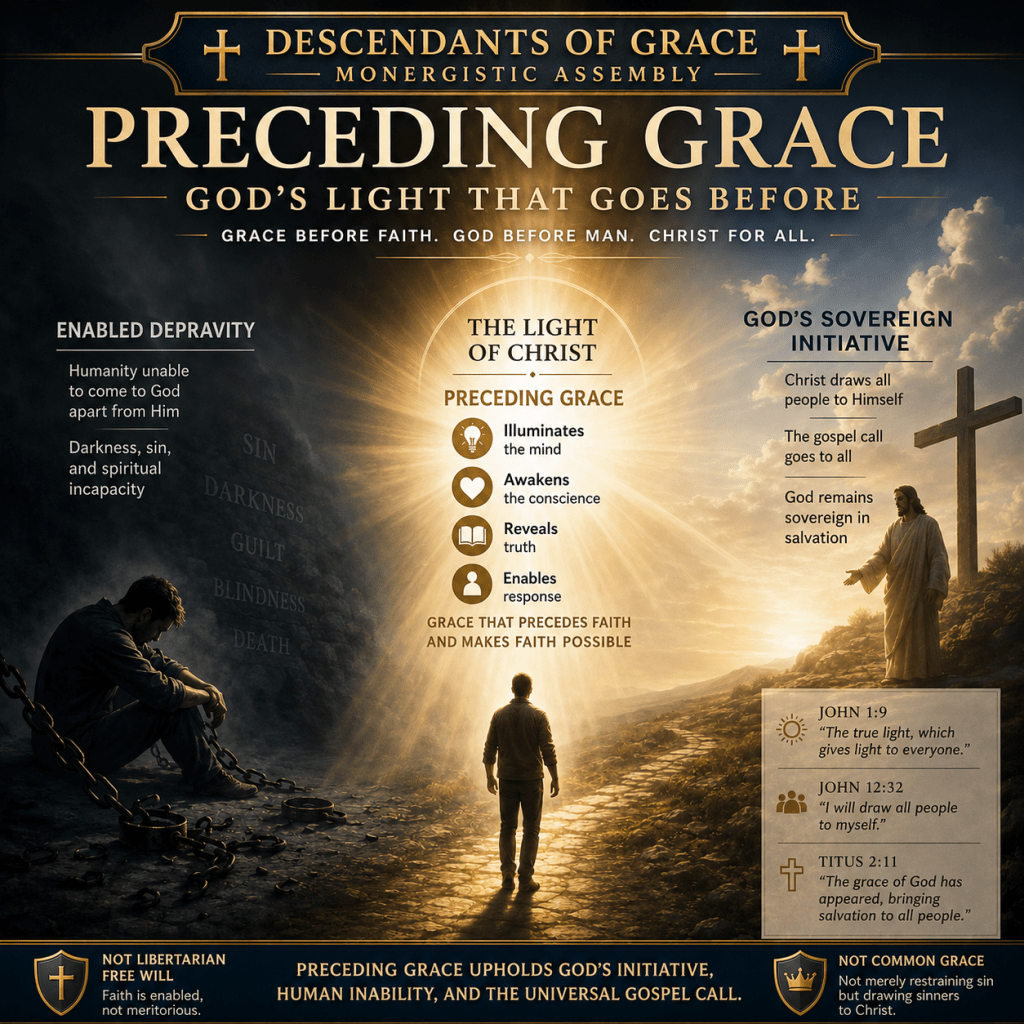
  • Preceding Grace: God’s Light that Goes Before

    In CLARE Theology, no sinner comes to God independently. Fallen humanity never initiates salvation, creates faith from within, or approaches Christ by unaided will. Jesus declares, “No one can come to me unless the Father who sent me draws him” (John 6:44). God’s grace always comes first. CLARE calls this Preceding Grace. Before any sinner believes, seeks, repents, or responds, God acts. Through Christ, Preceding Grace confronts human depravity and enables the sinner to genuinely encounter the Gospel. The will is not autonomous or naturally free; it is an enabled will, entirely dependent upon prior divine grace. Yet Preceding Grace can be resisted. Scripture warns, “You always resist the Holy Spirit” (Acts 7:51). Those under this universal divine enabling may reject God’s gracious drawing. If they believe, they cannot boast, because grace preceded and enabled every response. The Eternal Elect, however, experience God’s effectual and irresistible drawing. Those given to Christ by the Father will come to Him (John 6:37). Their salvation is certain—not because they resist better, but because God effectually brings them to Christ. Thus, grace always comes first, resistance is real, and election remains sovereign.

    In CLARE Theology, I prefer the term Preceding Grace rather than prevenient grace or common grace because it more clearly describes the unique work of God that comes before any human response while avoiding the theological assumptions often attached to those other terms.
    Preceding Grace is the gracious work of God flowing from the atoning work of Christ, whereby God enables fallen humanity to genuinely hear, understand, and respond to the gospel. Because of Enabled Depravity, humanity remains unable to come to Christ apart from divine action. Therefore, salvation always begins with God, not man.
    Unlike classical Wesleyan prevenient grace, Preceding Grace is not grounded in libertarian free will. It does not restore autonomous human freedom. Rather, it is a monergistic divine enablement that makes faith possible without making faith meritorious.
    Unlike Calvinistic common grace, Preceding Grace is specifically redemptive in purpose. Common grace restrains sin and preserves society, but Preceding Grace actively draws sinners toward Christ through the proclamation of the gospel and the illuminating work of God.
    Thus, Preceding Grace preserves God’s initiative, upholds human inability, avoids libertarianism, and explains how God sincerely calls all people to Christ while remaining fully sovereign in salvation.

    In CLARE Theology, Preceding Grace is the gracious work of God that comes before any human initiative, desire, or movement toward Christ. Fallen humanity does not naturally seek God, understand spiritual truth rightly, or possess the ability to come to Christ apart from divine intervention (Romans 3:10–11; Ephesians 2:1–3). Therefore, every genuine opportunity to respond to the gospel begins with God acting first. Preceding Grace is called preceding because it precedes human thought, conviction, faith, repentance, and conversion. God enlightens, convicts, draws, and enables sinners through the work of Christ and the ministry of the Holy Spirit. Without this prior action, no one would seek the Lord at all. As Jesus declared, “No one can come to me unless the Father who sent me draws him” (John 6:44, ESV). Yet for the Preceding Elect, this grace is resistible. God genuinely enables a response without coercing it. Scripture repeatedly portrays people resisting God’s gracious call (Acts 7:51; Matthew 23:37). The gospel invitation is sincere, and those enabled by Preceding Grace may still reject Christ through unbelief. Thus, Preceding Grace preserves two biblical truths simultaneously: God always takes the first step in salvation, and humans remain responsible for how they respond to the gracious call placed before them.

    In CLARE Theology, the Light of Christ is understood as God’s Preceding Grace—His gracious work that comes before conversion, before faith, and before any human response. This concept is rooted in passages such as John 1:9, which says that Christ is “the true light, which gives light to everyone.” The Light of Christ is neither saving regeneration itself nor natural human ability. Rather, it is Christ’s universal gracious influence upon fallen humanity. Because of the fall, mankind is incapable of coming to God apart from divine initiative. Yet through the work of Christ, God grants a measure of spiritual illumination to all people. This illumination exposes sin, awakens conscience, reveals truth, and enables sinners to recognize God’s call. It is grace that precedes faith. This understanding harmonizes with John 12:32, where Jesus declares that He will draw all people to Himself, and Titus 2:11, which states that the grace of God has appeared, bringing salvation to all people. In CLARE Theology, this universal drawing and enlightening ministry is called Preceding Grace. Thus, the Light of Christ is God’s gracious illumination shining into human darkness, overcoming the helplessness of Enabled Depravity and making every person genuinely accountable to respond to the gospel call. It is Christ’s light going before salvation, preparing the way for faith.

    Enabled Depravity is the CLARE doctrine that describes humanity’s actual condition after the redemptive work of Christ is applied through God’s universal Preceding Grace. Humanity remains fallen, corrupted by sin, spiritually incapable of saving itself, and unable to produce saving faith apart from divine action. However, because of Christ’s atoning work and God’s gracious initiative, sinners are enabled to hear, understand, and respond to the gospel. Unlike the traditional Calvinist concept of Total Depravity, which emphasizes complete inability apart from special saving grace, Enabled Depravity teaches that God has already acted toward humanity through Christ, extending a universal enabling influence. This grace does not regenerate, justify, or save by itself, but it removes absolute inability and makes genuine gospel response possible. Enabled Depravity is not free will, autonomous choice, or human merit. Every movement toward God remains dependent upon divine grace. Without God’s preceding action, no sinner would seek Christ. Yet this grace may be resisted by some and embraced by others according to God’s sovereign purposes. Key passages supporting this doctrine include John 1:9, John 12:32, Titus 2:11, Romans 3:10–23, Ephesians 2:1–5, and Acts 17:27–28. Enabled Depravity preserves both humanity’s fallen condition and God’s universal initiative in Christ.

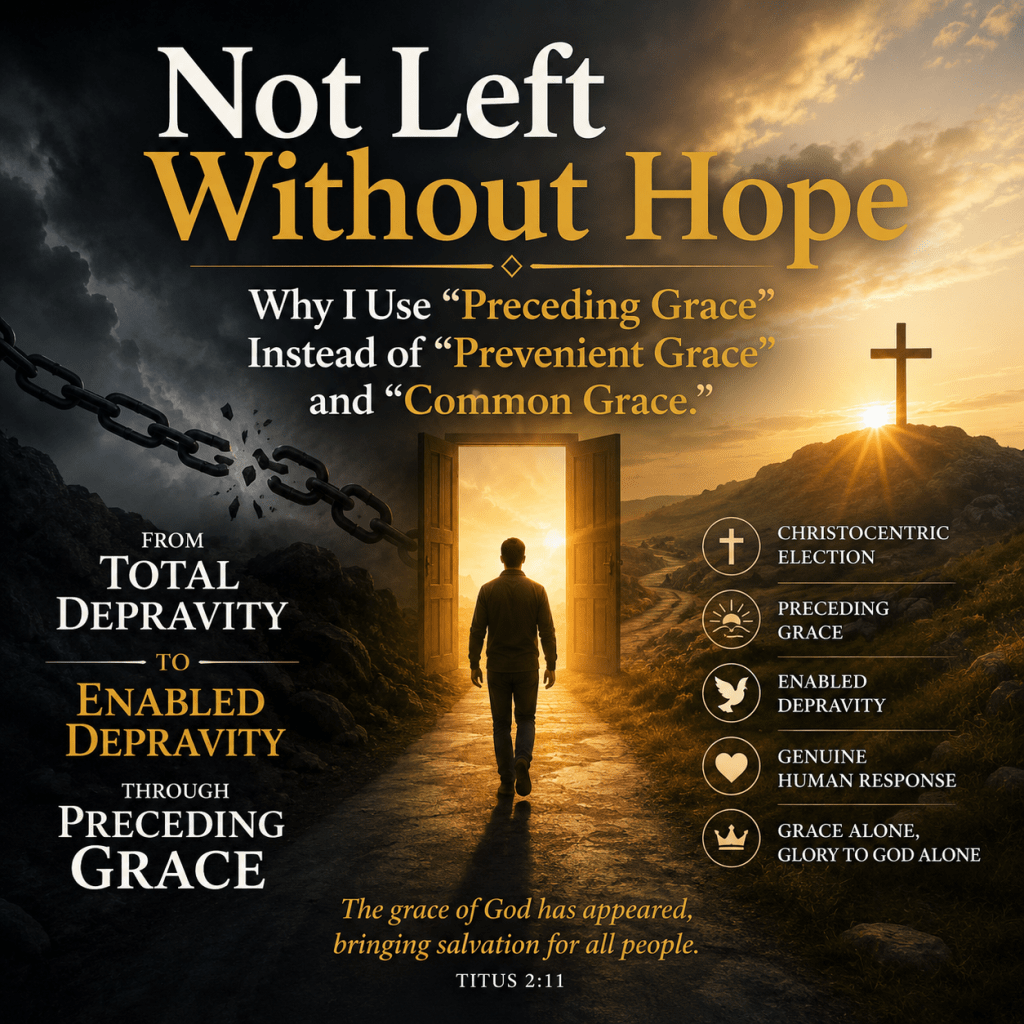
  • CLARE Theology: Not Left Without Hope: Why I Use “Preceding Grace” Instead of “Prevenient Grace” and “Common Grace.”

    I use the term Preceding Grace because words shape doctrine, and doctrine shapes devotion. When I speak about the Grace that comes before repentance and faith, I want the emphasis to fall on God’s action, not on human autonomy. Jesus says, “No one can come to me unless the Father who sent me draws him,” and yet He also says, “when I am lifted up from the earth, I will draw all people to myself” (John 6:44; 12:32, ESV). For me, those two texts already tell the story: Grace is prior, Grace is Christ-centered, and Grace is not a reward for the sinner’s first movement. 

    I do not reject the historical concern behind the older term ‘prevenient grace’. In fact, the Christian tradition has long confessed that Grace comes first. Augustine argues that there is “no merit in men’s choice of Christ” unless God’s Grace was already there before that choosing. Aquinas later explains that Grace is called prevenient because it causes earlier effects in us before later ones. John Wesley, in turn, speaks of “preventing grace,” the older English way of saying Grace that goes before. So my preference for Preceding Grace is not a rejection of history. It is an attempt at pastoral clarity. 

    “God’s grace was prevenient in His choosing them.”

    Reference: Augustine, On Grace and Free Will, ch. 38, AD 426/427. 

    The reason I do not simply keep the term prevenient Grace is that, in many modern ears, it sounds as if Grace merely restores to man a decisive, self-determining freedom that finally makes the sinner the ultimate cause of coming to Christ. Yet I do not believe fallen man comes to Christ by autonomous free will. I appreciate the historic insistence that Grace comes first. I do not affirm that the sinner, once “enabled,” becomes an independent spiritual first cause. Even within Wesleyan usage, prevenient Grace is often described as enabling those who will respond, and Wesley himself famously speaks of a “measure of free-will” restored by Grace. My concern is that many readers hear that language and interpret it as autonomy. I want a term that keeps their eyes on divine initiative. 

    At the same time, I want to say something else clearly: the Calvinist doctrine of Total Depravity is not wrong if we are speaking about what fallen human nature is in itself. Paul says, “None is righteous, no, not one,” “no one seeks for God,” and “all have sinned and fall short of the glory of God” (Rom. 3:10–12, 23, ESV). He says we were “dead in the trespasses and sins” (Eph. 2:1, ESV). Jesus says the sinner is “a slave to sin” (John 8:34, ESV), and Paul adds that the mind set on the flesh “does not submit to God’s law; indeed, it cannot,” and that those in the flesh “cannot please God” (Rom. 8:7–8, ESV). That is why I am fully willing to say that Total Depravity is ontologically true of fallen humanity. 

    But that is not the end of the matter. My claim is that Preceding Grace modifies the condition of fallen humanity from hypothetical Total Depravity to actual Enabled Depravity. Why do I say that? Because Scripture also says that Christ is “the true light, which gives light to everyone” (John 1:9, ESV); that when He is lifted up He will “draw all people” to Himself (John 12:32, ESV); that “the grace of God has appeared, bringing salvation for all people” (Titus 2:11, ESV); that God “desires all people to be saved and to come to the knowledge of the truth” (1 Tim. 2:4, ESV); that the Spirit will “convict the world” (John 16:8, ESV); and that God’s kindness is “meant to lead” sinners “to repentance” (Rom. 2:4, ESV). These texts do not teach that all are saved. They do teach that fallen humanity is not left in a bare state of unaddressed ruin. Humanity is met, confronted, illumined, drawn, and convicted by God. 

    This is why I use the term ” Enabled Depravity.” Humanity remains depraved. Humanity does not become neutral. Humanity does not become naturally free. Humanity does not become spiritually autonomous. But because of God’s prior Grace in Christ, humanity is no longer merely considered in abstraction as if humanity existed outside the reach of divine drawing. In other words, while humanity is fallen and incapable of saving itself, we should not describe humanity as though God has left humanity entirely to its fallen condition. Because Christ has entered history and extends “Preceding Grace,” or the Grace that preceded it, humanity now exists under a real divine drawing that enables a genuine response to the gospel. In that sense, Total Depravity is hypothetical in present experience. It tells the truth about what fallen nature is apart from Grace; yet because Preceding Grace is already operative in the world, the actual condition of humanity is better described, in this framework, as Enabled Depravity. 

    John Wesley comes surprisingly close to this point when he says there is no man now in a “state of mere nature.” That statement is extremely important for me. It means we should not describe the present human condition as if God had left the race wholly untouched after the fall. The sinner remains ruined in Adam, yes. But the sinner also stands beneath the prior activity of Christ’s light, Christ’s drawing, God’s kindness, and the Spirit’s conviction. Enabled Depravity, therefore, is not a denial of ruin. It is a description of ruined humanity under preceding Grace. 

    “There is no man that is in a state of mere nature.”

    Reference: John Wesley, On Working Out Our Own Salvation, Sermon 85, Sept.–Oct. 1785. 

    This also explains why I reject libertarian free will. By that phrase, I mean the idea that the decisive power of contrary choice finally lies in the autonomous self. I do not believe Scripture teaches that. Jesus says no one can come unless drawn (John 6:44). Lydia believed because “the Lord opened her heart” (Acts 16:14, ESV). Paul says, “because of him you are in Christ Jesus” (1 Cor. 1:30, ESV), and Ephesians says salvation is “not your own doing” (Eph. 2:8, ESV). Yet Scripture also says, “you always resist the Holy Spirit” (Acts 7:51, ESV). So the response of man is real, but it is never autonomous. The sinner does not come to Christ by self-originated freedom; he comes because God precedes him with Grace and enables his response without ceasing to be God. 

    At this point, I need to distinguish Preceding Grace from Calvinistic Common Grace. I do not deny the truth that Reformed theology is trying to protect there. Scripture plainly teaches that God “makes his sun rise on the evil and on the good” (Matt. 5:45, ESV), and that He gives “rains from heaven and fruitful seasons,” filling human hearts “with food and gladness” (Acts 14:17, ESV). Reformed writers rightly use the term “common Grace” for God’s universal providential goodness, restraint of evil, and preservation of a fallen world. Kuyper’s great contribution was to insist that the world is not less sinful because man is less corrupt, but because God curbs the outworking of sin. 

    “He curbs the operations of Satan, death, and sin.”

    Reference: Abraham Kuyper, Principles of Sacred Theology, as quoted in The Goodness of God and Common Grace; Kuyper (1837–1920). 

    But my point is that Preceding Grace is not exhausted by that category. Common Grace, in Reformed usage, represents non-saving favor and restraint. Preceding Grace, as I use it, points to a more explicitly Christological and redemptive direction: illumination, drawing, conviction, witness, and gracious enablement toward repentance and faith. Herman Bavinck is helpful here because he links Christ the Logos, common witness, and the broader theater in which Grace addresses humanity. That does not mean Bavinck meant CLARE by that language. It does mean the path is not unnatural. 

    “he enlightens every human coming into the world.”

    Reference: Herman Bavinck, Reformed Dogmatics, vol. 4, ch. 1; cited excerpt from Monergism; Bavinck (1854–1921). 

    This is also where I introduce the CLARE distinction between the Eternal Elect and the Preceding Elect. This distinction flows directly from Christocentric Election, Enabled Depravity, and Preceding Grace.

    By the Eternal Elect, I mean those spoken of in Ephesians 1:4, where God “chose us in him before the foundation of the world” (ESV). I also hear that note in John 6:37, where Jesus says, “All that the Father gives me will come to me” (ESV). This is Election in its eternal and divine origin. These are those whom God chose in Christ before creation and whom He irresistibly brings to saving faith according to His eternal purpose.

    The Eternal Elect are therefore not merely invited to Christ; they are effectually and infallibly brought into union with Him. Their salvation rests upon God’s eternal decree and cannot ultimately fail because God Himself ensures their coming.

    But CLARE Theology does not stop there.

    Classical Calvinism often divides humanity into two ultimate groups: the Elect and the Reprobate. The Elect are irresistibly brought to salvation. The Reprobate remain in Total Depravity and therefore cannot positively respond to God because they are never given saving Grace. In that framework, those who are not eternally elected possess no genuine hope of salvation.

    CLARE Theology takes a different approach.

    While affirming Eternal Election, CLARE rejects the conclusion that all who are not Eternally Elect are therefore hopelessly reprobate. Christ’s atonement was sufficient for the entire world. God’s Preceding Grace extends universally. Christ is the true light who “gives light to everyone” (John 1:9, ESV). He draws “all people” to Himself (John 12:32, ESV). The Grace of God has appeared “bringing salvation for all people” (Titus 2:11, ESV). The Spirit convicts “the world” (John 16:8, ESV).

    For this reason, humanity is not divided between the Eternally Elect and the hopelessly abandoned. Humanity exists under Enabled Depravity.

    This means that while fallen humanity remains incapable of saving itself, God has not left humanity in a condition where response to Him is impossible. Christ’s atonement and God’s Preceding Grace modify the lived condition of fallen humanity from hypothetical Total Depravity to actual Enabled Depravity.

    The sinner remains ruined.

    The sinner remains dependent.

    The sinner remains incapable of self-salvation.

    Yet the sinner is not abandoned.

    The sinner is illumined, confronted, convicted, drawn, and enabled through God’s gracious action in Christ.

    This is where the doctrine of the Preceding Elect emerges.

    By the Preceding Elect, I do not mean people who make themselves elect through autonomous free will. Nor do I mean that sinners independently choose God apart from Grace. Rather, I mean those who, though not chosen as individuals in Eternal Election, are nevertheless enabled by God’s Preceding Grace through Christ’s sufficient atonement and, within the condition of Enabled Depravity, come to repentance and faith, thereby becoming elect through union with Christ, the Elect One.

    The Preceding Elect become Elect because they become united to Christ.

    Their Election is not grounded in autonomous willing.

    Their Election is not grounded in self-generated faith.

    Their Election is not grounded in personal merit.

    Their Election is grounded in Christ.

    Paul repeatedly speaks this way.

    “Because of him you are in Christ Jesus” (1 Cor. 1:30, ESV).

    Believers are sons of God “through faith” in Christ Jesus and become Abraham’s offspring because they belong to Christ (Gal. 3:26–29, ESV).

    Likewise, Paul speaks of salvation occurring “through sanctification by the Spirit and belief in the truth” and through God’s call in the gospel (2 Thess. 2:13–14, ESV).

    The pattern is significant.

    God acts first.

    Grace precedes.

    The Spirit convicts.

    Christ draws.

    The gospel calls.

    Faith responds.

    Union with Christ follows.

    Election is realized in Christ.

    The Preceding Elect therefore do not become Elect because they possessed libertarian free will. They become Elect because God’s Grace made their response possible.

    At this point, an analogy may be helpful.

    Imagine two men trapped in a burning building.

    The first is carried out by a firefighter who determined beforehand that he would certainly rescue him. The firefighter reaches him, lifts him from the flames, and ensures his rescue. This resembles the Eternal Elect.

    The second man is also reached by the firefighter. He is awakened from sleep. He is shown the path of escape. He is repeatedly urged to follow. He does not extinguish the fire. He does not create the exit. He does not rescue himself. Every possibility of survival depends entirely upon the firefighter’s intervention. Yet he may either follow the rescuer or resist the rescue. If he follows, his salvation remains entirely dependent upon the rescuer’s action. This resembles the Preceding Elect.

    In both cases, the rescuer receives the glory.

    In neither case does the victim save himself.

    Or consider another analogy.

    Imagine a dark room.

    Eternal Election is like a blind man’s eyes being infallibly opened so that he certainly sees the light.

    Preceding Grace is like the light entering the room itself. The light makes sight possible. Those who see do so because of the light. They did not create vision. They did not create illumination. The light came first.

    Some look toward the light.

    Others shut their eyes against it.

    Yet in both cases, sight was possible only because light entered the room.

    Likewise, salvation is only possible because Christ first enters the darkness of the human condition.

    This distinction allows me to preserve what I believe Scripture preserves.

    Election is never severed from Christ.

    Election is never grounded in autonomous human willing.

    Election is never reduced to philosophical determinism.

    The Eternal Elect speaks of God’s eternal purpose in Christ.

    The Preceding Elect speaks of the historical and redemptive way God’s Grace reaches persons through illumination, conviction, drawing, and enablement.

    Both categories find their meaning in Christ.

    The Eternal Elect are chosen in Christ from eternity and irresistibly brought into union with Him.

    The Preceding Elect become Elect through union with Christ by means of God’s Preceding Grace operating within Enabled Depravity.

    In both cases, Christ is the ground of Election, Grace is the cause of salvation, and boasting is excluded.

    Here, I also find early Christian witnesses helpful.

    Justin Martyr speaks of the Logos as present among humanity, and Irenaeus describes salvation through the incarnate Word as humanity’s entry into adoption. Those voices do not erase important doctrinal differences across the centuries. Still, they reinforce an important instinct: the story of salvation begins with God’s prior movement toward us in His Word and Son, not with the sinner’s autonomous decision.

    “The seed of reason [the Logos] implanted in every race of men.”

    Reference: Justin Martyr, Second Apology, ch. 8; Justin Martyr (c. 100–c. 165).

    Recommended Reading

    Augustine, On Grace and Free Will — still one of the clearest early Christian statements that Grace does not destroy will, yet precedes and enables all good willing. 

    Thomas Aquinas, Summa Theologiae, I–II, q. 109 and q. 111 — essential for the classical distinction between Grace as inward divine help, and for the formal language of prevenient and subsequent Grace. 

    John Wesley, “On Working Out Our Own Salvation” — crucial for the older English language of “preventing grace,” for the denial of bare natural ability, and for the claim that no one now exists in a merely natural condition untouched by Grace. 

    Abraham Kuyper, Common Grace: God’s Gifts for a Fallen World, vol. 1 — useful not because it says the same thing as CLARE, but because it gives the strongest Reformed account of Grace as restraint and preservation, which your article needs to distinguish from Preceding Grace. 

    Herman Bavinck, Reformed Dogmatics, vol. 4, ch. 1 — especially valuable for connecting Christ as Logos, divine witness in creation and history, and the broader theater in which the gospel call appears. 

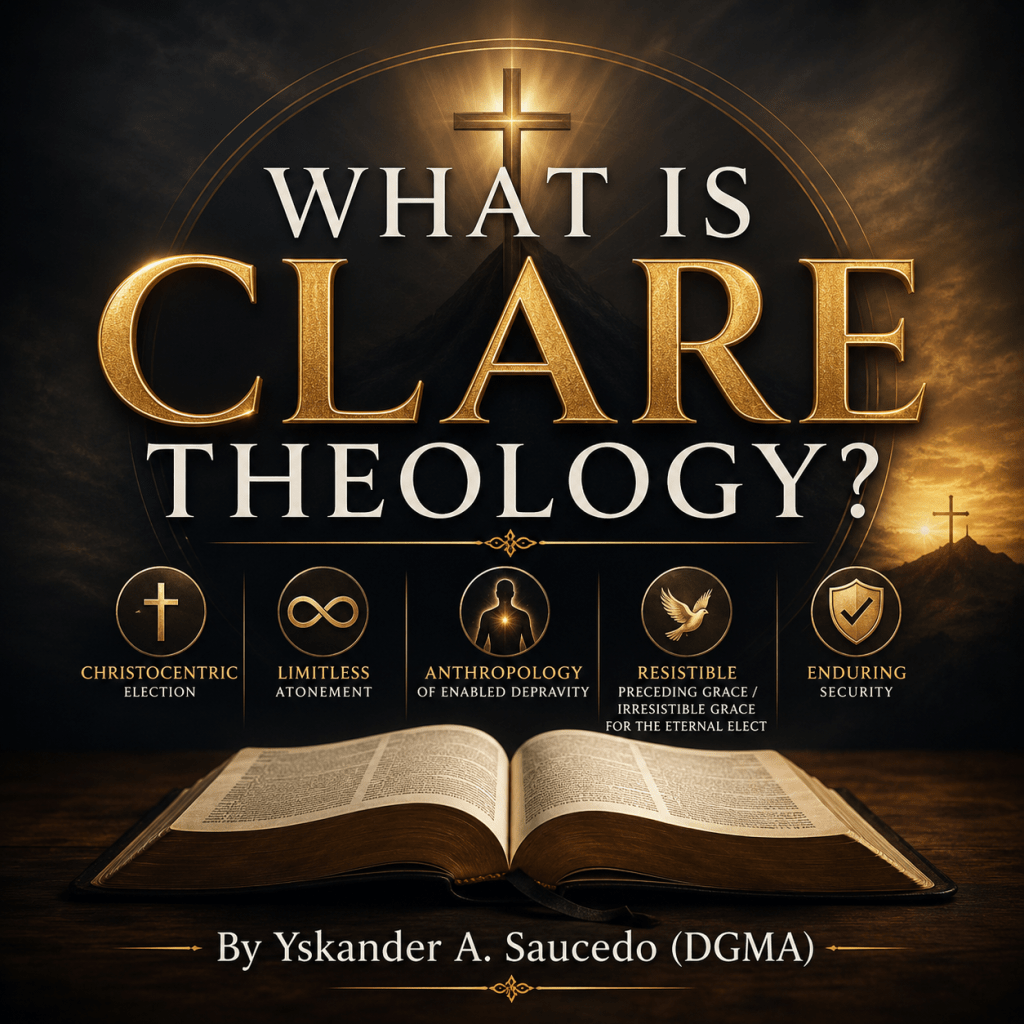
  • What Is CLARE Theology?

    What Is CLARE Theology?

    By Yskander A. Saucedo (DGMA)

    Founder and Director of Descendants of Grace Monergistic Assembly

    And DGMA.Doctrine Productions

    Christian theology has long wrestled with difficult questions concerning grace, election, free will, sovereignty, and salvation. Across church history, believers have often found themselves divided between theological systems that emphasize either God’s sovereignty or man’s responsibility. Yet Scripture consistently presents both realities together under the supremacy of Christ.

    CLARE Theology was developed as an attempt to articulate a Christ-centered, monergistic framework that seeks to preserve the fullness of biblical revelation without forcing Scripture into categories that may oversimplify the mystery of God’s redemptive work.

    CLARE stands for:

    • C — Christocentric Election
    • L — Limitless Atonement
    • A — Anthropology of Enabled Depravity
    • R — Resistible Preceding Grace / Irresistible Grace for the Eternal Elect
    • E — Enduring Security

    At its core, CLARE Theology insists that salvation begins, continues, and ends in Christ.


    Christ at the Center

    Many theological systems begin primarily with man’s condition or with abstract decrees concerning predestination. CLARE Theology begins with Christ Himself.

    The apostle Paul writes:

    “He chose us in him before the foundation of the world, that we should be holy and blameless before him.” — Ephesians 1:4 (ESV)

    Election is not viewed merely as an isolated decree detached from Christ, but as something eternally centered in Him. Christ is not secondary to election — Christ is the foundation, purpose, and fulfillment of election.

    This Christ-centered emphasis echoes the language of early church fathers such as Irenaeus of Lyons, who frequently emphasized that all of salvation history is summed up and recapitulated in Christ. In Against Heresies, Irenaeus wrote that Christ “became what we are, that He might bring us to be even what He is Himself.” This Christological focus remains foundational to CLARE Theology.


    Why CLARE Was Developed

    CLARE Theology emerged from the conviction that certain theological debates have often created false dilemmas.

    For example:

    • Must grace always be irresistible?
    • Does human responsibility require autonomous free will?
    • Must atonement be either entirely limited or universally saving?
    • Can God sovereignly know all contingent outcomes without surrendering His sovereignty?

    CLARE seeks to address these tensions by maintaining that God’s sovereignty and genuine human accountability coexist under divine providence.

    Scripture repeatedly affirms both truths simultaneously.

    Jesus declared:

    “All that the Father gives me will come to me, and whoever comes to me I will never cast out.” — John 6:37 (ESV)

    Yet Scripture also warns humanity against resisting God:

    “You stiff-necked people… you always resist the Holy Spirit.” — Acts 7:51 (ESV)

    Rather than dismissing one text in favor of another, CLARE Theology seeks to preserve the total witness of Scripture.


    Anthropology of Enabled Depravity

    One of the most distinct aspects of CLARE Theology is the doctrine of Enabled Depravity.

    CLARE affirms humanity’s radical corruption through sin. Humanity is fallen, spiritually dead apart from God, and utterly dependent upon divine grace. However, CLARE also teaches that because of Christ’s redemptive work in history, humanity does not exist in a state of absolute abandonment from divine influence.

    As Jesus declared:

    “And I, when I am lifted up from the earth, will draw all people to myself.” — John 12:32 (ESV)

    This drawing does not guarantee salvation for every individual, but it does affirm the universal activity of God’s grace through Christ in history.

    Unlike libertarian concepts of “free will,” CLARE Theology maintains that human beings are enabled by grace but never possess absolute autonomous freedom. God alone possesses true and absolute free will.

    This concern reflects ideas seen in Augustine of Hippo, who argued that fallen humanity cannot return to God apart from grace. Augustine famously wrote:

    “Man’s will is not free without God’s grace.”

    CLARE Theology agrees with Augustine regarding humanity’s dependence upon grace while further emphasizing the universal historical implications of Christ’s redemptive work.


    A Christ-Centered Monergism

    CLARE Theology is monergistic in the sense that salvation originates in God alone. Grace precedes all human response. God is always the initiator of salvation.

    As Scripture teaches:

    “We love because he first loved us.” — 1 John 4:19 (ESV)

    Yet CLARE also recognizes biblical passages showing humanity resisting divine conviction and revelation. Therefore, CLARE distinguishes between:

    • God’s universal preceding grace,
    • and God’s irresistible saving work toward the eternal elect.

    This framework seeks to uphold both God’s sovereignty and the sincerity of the gospel call to the world.


    The Purpose of CLARE Theology

    CLARE Theology is not an attempt to create theological novelty for its own sake. Its goal is to exalt Christ, defend the authority of Scripture, encourage serious theological reflection, and proclaim the gospel with clarity.

    The ultimate purpose is not merely to win doctrinal arguments, but to direct people toward Christ Himself.

    As the apostle Paul declared:

    “For from him and through him and to him are all things. To him be glory forever. Amen.” — Romans 11:36 (ESV)

    Theology that does not lead to worship ultimately fails its purpose.

    CLARE Theology exists to proclaim:
    Christ above systems. Christ above pride. Christ over everything.

  • Jesus gave a warning in Matthew 7:15: “Beware of false prophets who come to you in sheep’s clothing but inwardly are ravenous wolves.” A few weeks ago, we completed our lessons in early church heresies. Most of the heresies revolved around the deity of Christ and His ontological existence (Trinity). Some heretics were Christians attempting to reconcile how to maintain monotheism (worship of one God) while at the same time worshiping Jesus Christ as the Son of God, while worshiping God the Father, and not seem like polytheists (worship of multiple gods). Consequently, some of the heresies that emerged were Arianism, which holds that Jesus is a created being. Modalism, which is the belief that the Father, Son, and Holy Spirit are not three persons, but are all mere titles and modes of expressions used by God to express himself to humans at different times. Tritheism, which is the belief that the Father, Son, and Holy Spirit are not three co-equal and eternal persons as one God or substance but are three separate gods instead of one. There are several more heresies regarding the belief in the Godhead and the being of Jesus Christ but were all settled in great debate through church councils. One of those debates is the Council of Nicaea which confirmed that the Son of God was never created and existed through all eternity one and the same substance as the Father. Beliefs such as Arianism were judged according to scripture and condemned as heresy. Although these heresies have been tried and condemned by God’s providence and sovereignty. Sovereignty meaning God’s absolute authority to rule over all His creation, and providence meaning how God actively applies His sovereignty over all His creation. Some of these early heresies have not disappeared but the demonic forces in this world have found their application in the false religions of our day. Currently in our men’s meetings on Tuesday evenings we are studying these false religions and learning their false doctrines in contrast to the truth of God in His Word. Precept against precept. Doctrine against doctrine. Our true God verses their false gods. For example, we have encountered how the Seventh Day Advantest are still trusting in their works as they earn their way to heaven in a doctrine known as the “Investigative Judgement.” Where the death and resurrection of Jesus was not enough to atone for the sins of the world and Jesus is currently at a higher state of heaven reviewing the lives of professed “Christians” for their authenticity of their repentance. In other words, the Grace of God and our Faith in Christ is not enough. Arianism has crept its way into Jehovah’s Witness doctrine as they believe Jesus was the created Michael the Archangel before coming to earth. Tritheism or Polytheism has crept its way into Mormonism as they are taught there are multiple gods and we ourselves may become a god after death and perhaps given our own planet to rule as god. Finally, my brothers and sisters. I leave you with 1Timothy 4:1 “Now the Spirit expressly says that in latter times some will depart from the faith, giving heed to deceiving spirits and doctrines of demons.”  Study the Word of God and sound biblical doctrine earnestly.

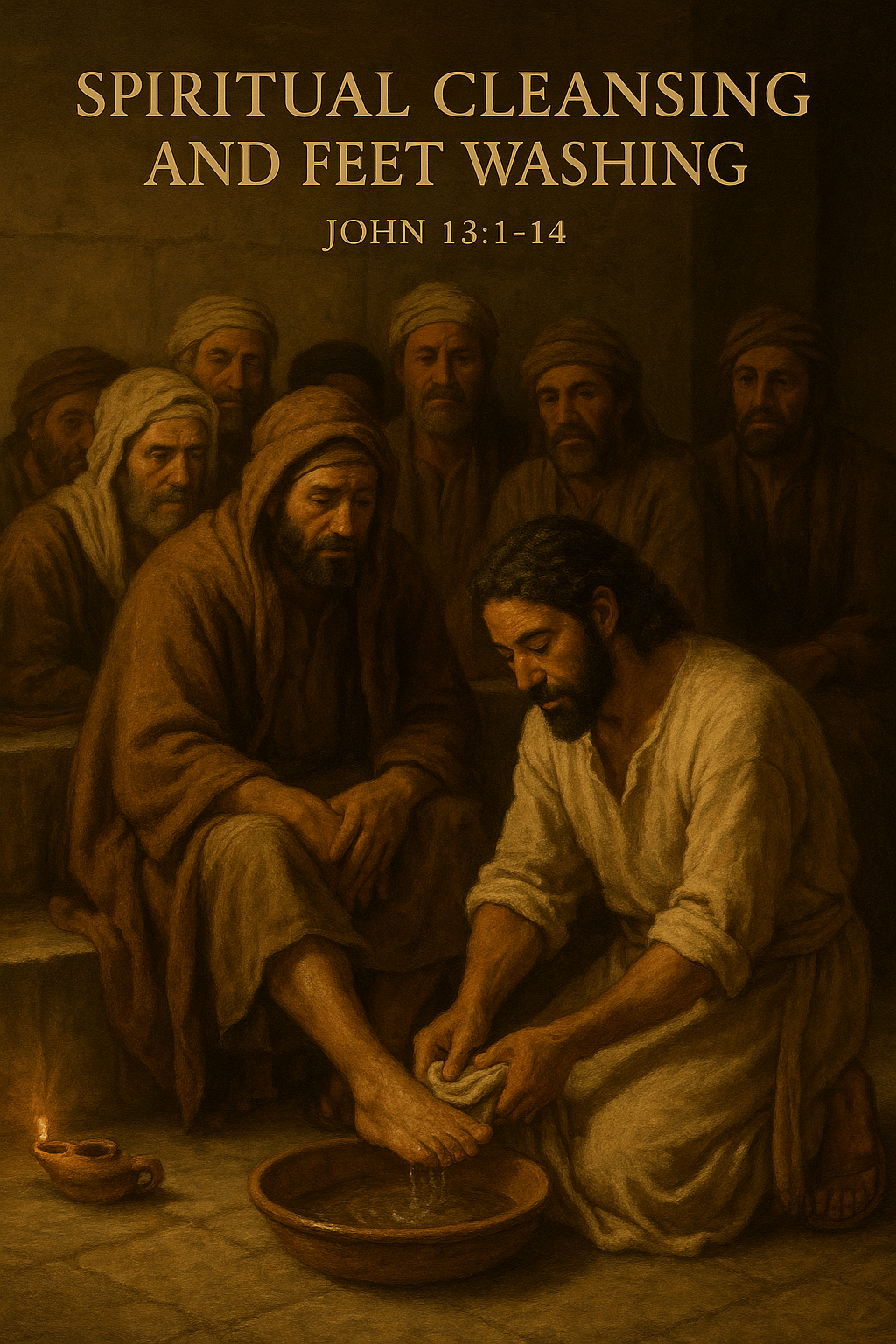
  • Spiritual Cleansing and Feet Washing

    John 13:1-14, John 14:1-6

    The words Jesus speaks take place on the night before His crucifixion, during the Last Supper with His disciples. Jesus talks with them about his departure from this world. He predicts to them the betrayal of Judas and Peter’s denial. All these things left the disciples confused, perplexed, and troubled. Not only were the disciples troubled in their hearts, but so was our Lord Jesus, troubled in His spirit, in John 13:21, when He began to speak about His impending betrayal. Jesus, taking notice of the demeanor of His disciples, comforts them in John 14:1 by redirecting their focus toward God. “Let not your hearts be troubled. Believe in God; believe also in me. You who are here today and have placed your faith in Jesus Christ are also His disciples. Not only disciples, but you are His bride, His church, His children, and He loves you. He gave His life for you. Considering those facts, what has troubled your heart and mind in the past? What currently troubles your mind and heart now? Recognize that in this world, we will continue to encounter troubling circumstances. But our God is sovereign. Think of God. Believe in God. Believe in Christ. This belief is not just a mere cognitive acknowledgement. Belief in God is understanding who He is as declared by the scriptures. Belief in Christ is understanding who He is as declared by the scriptures. Belief in the Holy Ghost is who He is, as declared by the scriptures. Having an understanding of the scriptures of who and what God is as the Godhead is to know God. So let me ask you. Do you know God? How often are you in the scriptures with understanding? Because to know God through the scriptures is to believe in God.

    As previously mentioned, Jesus was also troubled in His spirit before His betrayal. But He was motivated by His love for us. He was encouraged by the fact that He would soon be with the Father in Heaven. Jesus had confidence in Himself as the Son of God. That the Father had given all things to Him in His hands, that He came from the Father in Heaven, and that He was soon returning to His Father in Heaven. And similarly, you who have faith in Christ should have confidence in your new identity in Christ. You are now an adopted son of God and an adopted brother of our Lord Jesus Christ. We are no longer slaves to sin, but we are heirs through God, and we receive an inheritance through God, as written in

    Galatians 4: 4 – 6 But when the fullness of time had come, God sent forth his Son, born of woman, born under the law, to redeem those who were under the law, so that we might receive adoption as sons. And because you are sons, God has sent the Spirit of his Son into our hearts, crying, “Abba! Father!” So you are no longer a slave, but a son, and if a son, then an heir through God. 

    Heb 2:10 – 11 For it was fitting that he, for whom and by whom all things exist, in bringing many sons to glory, should make the founder of their salvation perfect through suffering. For he who sanctifies and those who are sanctified all have one source. That is why he is not ashamed to call them brothers.

    This is our identity. Not that we are somehow equal as sons of God with the Son of God. Jesus Christ is still God and our God. But the spiritual language communicates to us that the Father, Son, and Holy Spirit work in unity to unite us into their divine family. This is why we also have the right to address God in the same manner as Christ addresses God as Father. We are heirs of God. And Jesus speaks of our inheritance in John 14:2: “In my Father’s house are many rooms.”

    During the Lord’s Supper, as recorded in Luke 22:24-30, the disciples began to dispute among themselves about who was the greatest among them. Jesus realizes their selfishness and pride and gives them a sharp lesson in humility. Jesus tells them in,

    Luke 22: 26-30 But not so with you. Rather, let the greatest among you become as the youngest, and the leader as one who serves. 

    Luk 22:27  For who is the greater, one who reclines at table or one who serves? Is it not the one who reclines at table? But I am among you as the one who serves. 

    Luk 22:28  “You are those who have stayed with me in my trials, 

    Jesus reminds them that it is not who is the eldest or youngest among them that deserves prestige or authority over the other. It is not the one who holds a dignified position at the table waiting to be served at their request. Obviously, it is not the one who deserves honor and service, since (Jesus said) I myself am here among you all as a servant. Jesus reminds His disciples that they have been there with Him and have witnessed all His trials. Although they by now acknowledge He is the Son of God. Immanuel God in the flesh. The Word of God made manifest to them in a real physical reality. Yet, Jesus reminds them of the humility of the Son of God, exemplifying what humble submission to God the Father as a servant looks like, as they witnessed the afflictions and reproaches of the Scribes and Pharisees. As they listened to the snaring questions in attempts to stone their Master. Do you not think that at those moments, Jesus was not tempted to use His Godly attributes to escape trials and tribulations, the mockery, the beatings, the torment of the crucifixion? Jesus is the Sovereign King, yet He accepted the place of a servant by sacrificing His life on the cross for us. The Apostle John reveals in his writings the splendor of Christ’s deity, but also shows Christ’s humble submission to the Father’s will as the Father’s servant in John 5:19: “The Son can do nothing of His own accord, but only what He sees the Father doing.”

    John 6:38: “For I came down from Heaven, not to do mine own will.”

    John 7:16: “My teaching is not mine, but His who sent me.

    John 8:50: “Yet I do not seek my own glory; there is One who seeks it, and He is the judge.”

    John 14:24: “Whoever does not love me does not keep my words. And the word that you hear is not mine but the Father’s who sent me.”

    So I ask you all rhetorically today, who is the greatest among us all? Such a question should not be asked. Such a concept should not be thought of in our minds. The greatest is not the one with the most spiritual gifts. It is not the prophet, the healer, the evangelist, the bishop, the prayer warrior, the preacher, the Pastor, the teacher, or the church volunteer. But all of us need to humbly realize that whatever position we have in the kingdom of God is that of a servant doing the will of the Father from the highest to the lowest, from the richest to the poorest, to the most seemingly magnificent, the likes of Billy Graham preaching to tens of thousands and all over the world, to the seemingly modest volunteer who scrubs the church’s toilets. All are equally submitted to servanthood in the Kingdom of God to the Father’s will, and even if it leads to our death for the sake of the Gospel, as demonstrated by our master Jesus Christ.

    You’ve heard me mention the Kingdom of God several times. That is because we need to bear in mind the bigger picture Jesus is speaking about in Luke 22:29-30. Jesus said:

    Luk 22:29  and I assign to you, as my Father assigned to me, a kingdom, 

    Luk 22:30  that you may eat and drink at my table in my kingdom and sit on thrones judging the twelve tribes of Israel. 

    God has a Kingdom in heaven which He appointed to Christ. And in this Kingdom, Jesus has assigned a position to each of us as we serve our God on earth. We store our riches in heaven as we obey the will of the Father during our time on earth. In this Kingdom, there are many rooms, and our Savior Jesus Christ has gone to prepare a room for us. The Kingdom of God, in a real sense, belongs to us. So, we must act as if we believe the Word of God in this respect.

    Luke 12:32 Fear not, little flock, for it is your Father’s good pleasure to give you the Kingdom.

    Matthew 25:34 Then the King will say to those on his right, ‘Come, you who are blessed by my Father, inherit the kingdom prepared for you from the foundation of the world. 

    As we humbly serve God on earth, obeying the teachings of Christ and submitting to the will of the Father in servanthood. Yes, we have a motivating factor of attaining our riches in the Kingdom of God in heaven as our inheritance. But there is another motivating factor that we need to have in perspective. And to this point, 18th-century Bible expositor Matthew Henry wrote,

    “This kingdom he appointed to his apostles and their successors in the ministry of the gospel, that they should enjoy the comforts and privileges of the gospel, help to communicate them to others by gospel ordinances, sit on thrones as officers of the church, not only declaratively, but exhortatively judging the tribes of Israel that persist in their infidelity, and denouncing the wrath of God against them, and ruling the gospel Israel, the spiritual Israel, by the instituted discipline of the church, administered with gentleness and love. This is the honour reserved for you.”

    Listen church. God appointed the Kingdom to Christ, and Christ appointed the Kingdom to us. We are currently on assignment, serving in a real Kingdom of God in heaven as it transcends to the Kingdom of God on earth. The Kingdom of God reigns on earth through His visible church of Christ. We are all contributors in the church of Christ on earth, spreading the message of the Kingdom, and the message of the Kingdom is the Gospel of Christ. Our assignment as those appointed to the Kingdom of God is to contribute to the spreading of the Gospel of Jesus Christ on earth. And again, whether you hold a church office as a Deacon, Elder, Pastor, or perform other church functions or volunteer, it all contributes to the spreading of Christ’s victorious gospel of the Kingdom of God. (Speak about the victory of the Gospel).

    Now, returning to the events of the Lord’s supper. Jesus, acting in servanthood, removes His outer garments, He pours water into a basin, and begins to wash the disciples’ feet and wipes them with the towel wrapped around His waist. When the Lord came to Peter to wash his feet, Peter was reluctant to allow the Lord to wash him. Jesus said, “What I am doing you do not understand, but afterward you will understand. If I do not wash you, you have no share with me.” The King James Version reads, “You have no part with me. Notice that Jesus did not say If I do not wash your feet, you have no share in me. Instead, Jesus said If I do not wash you, you have no part in me. And the same applies to us today. If the Lord does not wash our sins away with His blood, we will have no part in Christ. You will remain stained with your sins with no righteousness to claim before God. And the only part you will have is a separation apart from God’s grace and mercy, and subject to His wrath. We ought to respond as Peter did. Peter’s response was for the Lord to wash not only his feet but his hands and head. Peter realized that what Jesus was doing was not just a mere act of humility, but the washing was symbolic of the cleansing of the spirit and not just the body. We need to have the same response as Peter. Calling out to the Lord to save us. To cleanse us from our sins, from our inadequate deeds that we try to pass off as good works without faith, which are as filthy rags to the Lord. We ought to cry out to God to grant us repentance, forgive our sins, and save us from eternal torment. Lord, don’t just wash my feet, wash my hands, my head, my body, my mind, my spirit, and soul so that I may have a part with you in eternity. Lord God, you prepared a place for me in heaven, and I want to be a part of your kingdom in heaven and serve you with humility on earth. Cleanse me, oh Lord, as it’s written in your scripture:

    Isaiah 4:4 When the Lord shall have washed away the filth of the daughters of Zion and cleansed the bloodstains of Jerusalem from its midst by a spirit of judgment and by a spirit of burning.

    Ezekiel 36:25 I will sprinkle clean water on you, and you shall be clean from all your uncleanness, and from all your idols I will cleanse you.

    Zechariah 13:1 On that day there shall be a fountain opened for the house of David and the inhabitants of Jerusalem, to cleanse them from sin and uncleanness.

    Acts 22:16 And now why do you wait? Rise and be baptized and wash away your sins, calling on His name.

    1Corinthians 6:9-11 Or do you not know that the unrighteous will not inherit the kingdom of God? Do not be deceived: neither the sexually immoral, nor idolaters, adulterers, nor men who practice homosexuality, thieves, the greedy, drunkards, revilers, nor swindlers will inherit the kingdom of God. And such were some of you. But you were washed, you were sanctified, you were justified in the name of the Lord Jesus Christ and by the Spirit of our God.

    Which of these sins have we been guilty of? But if we have called on the name of the Lord Jesus, all our sins are washed away. Sanctified and justified by the Spirit of our God. Thank you, Lord, for your grace and mercy.

    Do you want to be clean from all your impurities? Do you want to be cleansed by the blood of Christ? To be pardoned by God Himself? John 14:1 Believe in God and believe in Christ. Acts 22:16 What are you waiting for? Rise and be baptized, washing away all your sins and calling on the name of Jesus.  

    Jesus said something very interesting in response to Peter’s request to wash more than his feet. Jesus said:

    John 13:10 The one who has bathed does not need to wash, except for his feet, but is completely clean. And you are clean, but not everyone of you.”

    The one who is bathed is not in reference to someone who is baptized. It is in reference to one who has had all their sins washed away by Christ’s atoning sacrifice on the cross. The one who is bathed is the one who has been born again by the regenerating power of the Holy Spirit. The one who is bathed has confessed all their sins to the Father and has had their sins pardoned. The one who is bathed is justified to enter the Kingdom of God because of the faith they have in Christ. We are no longer held accountable by the law of Moses but instead accountable by our faith in Jesus Christ and His righteousness, which becomes our righteousness since we have none of our own to offer God the Father. To approach God with our own righteous works is to approach God defiled, unrighteous, full of unforgiven sin, and most importantly, without Christ and His righteousness.

                Jesus said if you’ve been bathed, you only need to wash your feet because you have been completely clean. You do not need to rewash repeatedly.

    The Song of Solomon 4:7 says, “You are altogether beautiful, my love; there is no flaw in you.” Once you are entirely cleansed, you are wholly forgiven for all your sins. There is no double jeopardy with God. He does not forgive you of sin and later raises the issue to condemn you. (Talk about Christ’s example of forgiveness).

    2Corinthians 5:17 Therefore, if anyone is in Christ, he is a new creation. The old has passed away; behold, the new has come.

    But do you believe it? Do you truly believe with faith and confidence that God has forgiven and Christ has washed away all your sins? The atonement of Christ is part of the Gospel of Christ. You cannot believe in the gospel only in part. If you believe in Christ, then you must believe in the entire gospel and not just in part. I know it may seem complicated to think that God would forgive us, or some of our sins. We have all sinned in different measures. But the grace, mercy, love, and forgiveness of God are qualities and attributes exclusive to God and have no measure, limits, or boundaries. If you believe in Christ, believe in His atoning work. But remember, for those who do not come to the Lord for the washing of their sins once and for all, the wrath of God against sin, evil, and those with unforgiven sin, the wrath of God is also an attribute without measure, limits, or boundaries. Choose life, choose Christ.

    After you’ve come to believe in Christ and His Gospel and have your sins pardoned, this does not mean you will never sin again. This does not mean you should not confess and ask God for forgiveness when you sin. And this is the relevance of Christ washing the disciples’ feet. I need you to understand this. The washing of the body is symbolic of the once-for-all atoning work of Christ – the one-time sacrifice of Jesus on the cross for all sin. However, we will continue to sin daily in thought or action. 1John1:8 reminds us that if at any time we say we have no sin, we deceive ourselves, and the truth is not in us. John 14:6 says Jesus is the truth that leads to the Father. If we do not have our minds renewed by the sound doctrines of the gospel, we do not have the truth, and if we do not have the truth, we do not have Christ.

    1John1:9 says if we confess our sins, He is faithful and just to forgive us our sins and to cleanse us from all unrighteousness.

    The forgiveness of God is an ongoing blessing and promise to us. But we cannot hide our sins from God. We must confess our sins directly to God, ask for forgiveness, repent, and believe He has forgiven us. Because as

    Proverbs 28:13 reads, Whoever conceals their sins does not prosper, but the one who confesses and turns from them is shown mercy.

    Christians listen carefully. In this world, we continually walk through the dirt and filth beneath our feet. We walk within a struggle of darkness and light, evil and good, unethical and immoral deeds, and righteousness. In that process, as we struggle to love Christ and submit to His commandments, we fall short daily, and our feet become soiled with the unclean things of this world. And so, our Lord makes daily intercessions for us and washes our feet, keeping us clean and undefiled before the Father in heaven. Do you understand the difference between being washed entirely once and for all and the necessity for the symbolic work of Christ washing your feet frequently? I hope so. Because in

    John 13:14 Jesus said, If I then, your Lord and Teacher, have washed your feet, you also ought to wash one another’s feet.

    Let me make something clear, that when Jesus spoke these words. He did not necessarily mean this as a sacrament or ordinance, such as baptism and participating in the Lord’s supper. But the symbolic lesson is that, just as Jesus washed your feet to cleanse you of your ongoing sin, so washing each other’s feet is comparable to forgiving each other when one sins against us. Jesus said in

    Matthew 6:12 Forgive us our debts, as we also have forgiven our debtors.

    James 5:16 Therefore, confess your sins to each other and pray for each other so that you may be healed. The prayer of a righteous person has great power as it is working.

    The final thing Jesus said in John 13:10 was that you are clean, but not everyone of you. By this time, it was revealed to Jesus who was to betray Him. And it may be that Jesus did wash Judas’ feet, but his entire body was not clean. And this is indicative of the fact that there will always be false conversions among us, and we judge them not in hypocrisy, as if we have never sinned as they have sinned, or as if we continually have no sin of our own. We judge them by their deeds and what they say, so that we may be watchers of false doctrine and those who may mean to cause harm to the body of Christ. However, this does not mean abandoning anyone entirely. There is no relief from responsibility to reach the lost. Let me remind you of

    Ezekiel 3:18-19 Eze 3:18  If I say to the wicked, ‘You shall surely die,’ and you give him no warning, nor speak to warn the wicked from his wicked way, in order to save his life, that wicked person shall die for his iniquity, but his blood I will require at your hand. 

    Eze 3:19  But if you warn the wicked, and he does not turn from his wickedness, or from his wicked way, he shall die for his iniquity, but you will have delivered your soul. 

    Is there anyone among you who is unclean? That has not been washed by the blood of Christ. That has not confessed their sins to God and begged for mercy and forgiveness. What are you waiting for? Rise and believe in God and Jesus Christ as the Son of God. Confess your sins to God, repent, and be baptized. Turn from the wicked things that God despises and walk in holiness, emulating the character of God and obeying Christ’s commandment because of your love for Jesus, because Jesus loved you to the point of His death on the cross. In the Father’s house, there are many rooms, and Jesus has gone to prepare a room for those who believe in Him. But there is only one way to the Father, and that is through Jesus Christ. There is only one truth in this world, and that is the Gospel of Jesus Christ. There is only one life eternal in paradise, and that is given through the life of Jesus Christ. Christ is all. Make Him all in your life and repent of your sins today. Tomorrow is not promised, and God may require your soul tonight. Are you fully cleansed by the washing of sin with Christ’s blood?

  • In The Beginning Genesis 1:1, 1:26

    Gen 1:1 In the beginning, God created the heavens and the earth. 

    In the beginning! It is fascinating that the Bible begins the first sentence with “in the beginning.” God is an eternal being. God has an infinite mind. He has an eternal mind. It logically follows that the prepositional phrase “in the beginning” would be a foreign concept to an eternal being because the idea of time is entirely foreign in eternity. Nevertheless, Moses begins his writing with a time reference. The beginning. I believe it reveals God’s love, Grace, mercy, and wisdom to use language that a finite mind can understand. God is an eternal being, and His existence requires no necessity or reference for time since His existence has no beginning or end. His angels are not eternal beings because they were created by God. Angels had a beginning; however, they may not have an end, so they qualify as infinite beings but not eternal. We see throughout scripture from Genesis to Revelation that God uses the structure of language and grammar to communicate effectively with His created beings. God knows there is no time reference in Heaven or His existence; He knows terms such as “time and “beginning” are something his created beings will comprehend since “time” and “beginning directly relate to the human experience. Another example of this language is in

    Genesis 6:6-7 (MKJV) And Jehovah repented that He had made man on the earth, and He was angry to His heart. And Jehovah said, I will destroy man whom I have created, from the face of the earth, both man, and beast, and the creeping thing, and the fowls of the air. For I repent that I have made them. 

    This is an example of how we see in many scriptures the use of hyperbole, metaphors, personifications, and anthropomorphisms in reference to God’s speech. We also see it in the speech of Christ throughout the synoptic gospels. These instances are essential to understand because they prevent the reader from error, such as thinking God changes His mind arbitrarily based on circumstance, as a human does. God is omniscient and immutable. He knows all things, and He does not change.

    Psalms 135:6 Whatever the LORD pleases, he does, in heaven and on earth, in the seas and all deeps. 

    Numbers 23:19 God is not man, that he should lie, or a son of man, that he should change his mind. Has he said, and will he not do it? Or has he spoken, and will he not fulfill it? 

    These passages read that God will do all His pleasure in heaven and earth. And unlike men who cannot keep their word and remain consistent. God keeps His word and nothing can change His mind. So what does it mean that God repented? When we think of the word repented in application to ourselves, we commonly think of regretting an action we’ve performed, feeling sorrow, and changing the course of our action in a way more favorable to God. But how can God repent? He does not. This is an example of hyperbole, an expression of an exaggeration not necessarily meant to be taken literally but used so we can effectively understand the mind and emotions of God.

    The Hebrew word used in this verse for repent is Nacham, which carries the meaning of sighing, breathing strongly, and implicating a sense of sorrow, not necessarily a changing of the mind, as if to say that God regrets ever creating us and if He could do it over He would not create us at all. Such an interpretation conveys that God made a mistake, and God making a mistake does not fall in the attributes or qualities of God’s being. The proper way to understand these verses is that the wickedness on earth had become so great that it actually made the LORD feel sorrow. This is why the translators of the English Standard Version changed the wording from the KJV and MKJV of “I repent that I have made them” to “I am sorry that I have made them.” We can learn from these passages that our actions and deeds on earth rouse God’s emotions. Think about that in an individual atmosphere between you and God. God is communicating to us through scripture that our actions and deeds do have an impact on God’s emotions. If we perform evil in His sight, it may rouse Him to anger and sorrow. If we love one another and perform righteous deeds with one another, it may pleasure God to the point of hearing the words of Christ in Matthew 25:23 “Well done, good and faithful servant.”

    In verse one, God is the Hebrew word Elohim; it is grammatically plural. Nevertheless, we know that there is only one God. We are a monotheistic religion.

    Deuteronomy 6:4 reads, “Hear, O Israel: The LORD our God, the LORD is one.

    1 Timothy 2:5 For there is one God, and there is one mediator between God and men, the man Christ Jesus. 

    There are passages where Elohim is used in context to communicate gods in a plural meaning, such as Exodus 20:3 “You shall have no other gods before me. The Hebrew word for gods in this verse is also Elohim. The principle here is that you must allow the context to determine how the definition is applied.

    Grammatically speaking, Genesis 1:1 does not express multiple gods or that our God, Elohim, exists as numerous people as individual gods. However, some theologians believe Elohim implies the Trinity doctrine in verse one. Perhaps I would not contest vigorously against the idea. At the same time, I would not strongly suggest the trinity concept from verse one as it seems to add too much to the context, which is unclear. There are many scriptures we can follow that imply the Triune doctrine. However, the plurality in verse one of Genesis, both theologians and commentators John Gill and John Calvin agree that the Hebrew word for Elohim is in context with God’s power in creation, which seems to suggest the plurality of God’s supreme power, majesty, and divine attributes.

    Let’s revisit the creation. Genesis 1:1 In the beginning God; God, the existence of God is already presupposed. No apologetics is given by Moses to prove the existence of God, and none need be given. In the beginning is the beginning as we know it through our finite minds. Once we understand the existence of consciousness, God, in the beginning, serves as the Christian’s maxim to believe in the existence of God. In the beginning, God is our maxim. For an in-depth understanding of a maxim and its application, read Immanuel Kant’s Categorical Imperative. For now, for simplicity’s sake, a maxim is a fundamental truth, a principle, a rule of conduct as an absolute standard of universal application. In the beginning, God is a universal maxim that all must presuppose the existence of God and all His sovereignty and majesty to the glory of God, amen!

    In the beginning, God created. God created everything out of nothing by the power of His word and breath.

    Psalms 33:6 By the word of the LORD the heavens were made and by the breath of His mouth all their host.

    God created everything with no help. It was by God alone that everything was created. Likewise,

    2 Corinthians 5:17-18 reads, Therefore, if anyone is in Christ, he is a new creation. The old has passed away; behold, the new has come. All this is from God, who through Christ reconciled us to Himself and gave us the ministry of reconciliation.

    You and I and whoever is in Christ are a new creation. Just as the work of creation was accomplished by God alone, so was the work of our new creation in Christ was accomplished by God alone. The regenerating of our Spirit by the Spirit of God is analogous to being born again as a new creation, which had nothing to do with our own work, and God needed no assistance in our salvation. Our new creation and reconciliation to God by the blood of Christ was the work of God alone.

    Romans 3: 23-24 All have sinned and fall short of the glory of God, and are justified by his Grace as a gift, through the redemption that is in Christ Jesus.

    Ephesians 2: 7-8 For by Grace you have been saved through faith. And this is not your own doing; it is the gift of God, not a result of works, so that no one may boast.

    All the old, including our sins, disobedience to God’s law, and falling short of His glory, have passed away. Through faith, God has forgiven those who believe in His son, Jesus Christ. All to the glory of God, who saved us according to His work alone from the beginning. If we are a new creation, it should manifest a new way of life. If all the old things have been put away, then a new creation should result in new beginnings. We should have a new perspective and worldview as our minds are renewed by God’s word and the indwelling of the Holy Spirit in our lives. We are a new creation. Cappadocian Father Gregory of Nyssa, a fourth-century Christian theologian who significantly contributed to the doctrine of the Trinity and the Nicene Creed, wrote, “The new creation is the apostolic rule. And what this is, Paul makes abundantly clear in another section, saying: In order that I might present to myself the church in all her glory, not having spot or wrinkle or any such thing, but that she might be holy and without blemish. A new creature he called the indwelling of the Holy Spirit in a pure and blameless soul removed from evil and wickedness and shamefulness. For, when the soul hates sin, it closely unites itself with God, as far as it can, in the regimen of virtue; having been transformed in life, it receives the Grace of the Spirit to itself, becomes entirely new again, and is recreated.”

    This should drive us to ask ourselves, is this applicable to us today? Is the Holy Spirit indwelling within us? Have we removed ourselves from evil, wickedness, and anything shameful? Do we hate sin? Do we pray for God’s Grace in our lives to overcome sin? Have we repented of our sins? Have we been baptized in the name of the Father, Son, and Holy Ghost? Have we given our lives to Christ in faith that we may have our sins forgiven and reconciled to the Father?

    In the beginning, God. Has your name been written in the Book of Life from the beginning, or will you remain in sin and give yourself to worship the beast as written in Revelation 13:8?

    Revelation 13:8 And all who dwell on the earth will worship it, everyone whose name has not been written before the foundation of the world in the Book of Life of the Lamb who was slain.

    The Lamb of God was foreknown before the foundations of the world for our redemption. The fall in the Garden did not take God by surprise. God is all-knowing and omniscient, and He had a plan to redeem His creatures by the blood of Christ and your faith in God.

    1 Peter 1:19-21 but with the precious blood of Christ, like that of a lamb without blemish or spot. He was foreknown before the foundation of the world but was made manifest in the last times for the sake of you who through him are believers in God, who raised him from the dead and gave him glory, so that your faith and hope are in God.

    Listen, In the beginning, God. Has your name been written in the Book of Life from the beginning? I hope you see something very significant in these three verses of 1 Peter 1: 19-21. Not only is there the mention of Jesus Christ being foreknown by God before the foundation of the world, before the beginning, but these three verses also mention, “you who through Him are believers in God . . . so that your faith and hope are in God.” What does that convey to you about your existence in this world? We should understand how special and unique we are as creatures created in the image of God, foreknown by God in His mind before the foundation of the world, before the beginning when our names were written before the foundation of the world in the Book of life of the Lamb who was slain Revelation 13:8. To this effect, eighteenth-century biblical scholar John Gill wrote, “For all God’s decrees and appointments, relating either to Christ, or His people, are eternal; no new thoughts, counsels, and resolutions, are taken up by Him in time. The affair of redemption by Christ is no new thing; the scheme of it was drawn in eternity; the persons to be redeemed were fixed on; the redeemer was appointed in the council and covenant of peace; and even the very Gospel which proclaims it was ordained before the world, for our glory.” Somebody should give God praise. Someone should say amen to this. This is the Gospel of Christ, our Lord and Savior. We should thank God for His eternal work before the beginning because, in the beginning, God.

    I’d like to move our attention to Genesis 1:26

    Genesis 1:26 Then God said, “Let us make man in our image, after our likeness. And let them have dominion over the fish of the sea and over the birds of the heavens and over the livestock and over all the earth and over every creeping thing that creeps on the earth.”

    Earlier, we mentioned the plurality of God in Hebrew form, Elohim, and we see the plurality of language in verse 26 again when it reads, Let us make man in our image and likeness. Any credible and respectable bible scholar would agree that the phrase “let us make” is in reference to God’s own council among Himself or within His triune deity. After all, all three, the Father, Son, and Holy Ghost, participated in the creation in the beginning.

    We see in Genesis 1:2 that the Spirit of God hovered over the face of the waters.

    In John 1:3 it speaks of Jesus as the Word that all things were made through him, and without him was not any thing made that was made.

    Psalms 33:6 reads by the word of the LORD the heavens were made, and by the breath of His mouth all their host.

    In this verse, we have the Hebrew word for LORD, which is Jehova, and the Hebrew word for breath, which is Rooahk, which indicates wind or spirit.

    The Jews believed that the “us” in “Let us make” was God taking counsel with His angels. The problem is that verse 26 says we were made in the image and likeness of God, not the image and likeness of angels. Furthermore, from the Christian perspective, it is easy to see the Bible’s scriptural support to warrant the belief that when God says “us,” He exclaims His own deity and dignifies the uniqueness of man being created in God’s image. Ephrem the Syrian, a prominent Christian theologian and writer of the fourth century, wrote, “And God said let us make man. But to whom was God speaking? Here, as well as in every place where He creates, it is clear that He was speaking to His Son.”

    I want to highlight three critical propositions from Ephrem the Syrian. One, is that the belief that God was speaking to the Son or at least that the “Us” in Genesis 1:26 is a trinity reference going back to the early church fathers is evident. Second, the fact that the Father was speaking to the Son during creation corresponds with the scriptures, that all three persons of the Trinity were involved in creation, and that the belief goes back to early church history. Third, and perhaps to me, the most essential fact we attribute not just from Ephrem the Syrian, but of course from scripture, is the eternal pre-existence of the Son of God. Why is that third proposition so important? Because, there is a group of modern Christians, and whether they can be called Christians is debatable. The group I am referring to is the Oness Pentecostals. They adhere to Oness theology, a modern version of early church heresies called Sabelianism and Modalism. Generally, they believe that the Godhead does not exist as three coeternal persons. That means they believe the Father, Son, and Holy Spirit are not three different persons, but merely three different modes of expression of one God. In their view, the Holy Spirit does not have a coeternal existence apart from God. The Son did not exist with God the Father and the Holy Spirit in eternity past. The Oness theology teaches there has always only been one God that does not exist as three coeternal persons. Therefore, the incarnation of Christ is not the Son of God who existed in eternity “pre-incarnate.” I know this may sound complex and probably does not seem to make much of a difference to you right now. Let me, at least for now, solidify how we believe in the Trinity. I want to make sure you leave today with a concrete scriptural belief in the doctrine of the Trinity. I am going to drill you with scripture now. You may want to take notes. If not, just pay attention and listen to this message again through your multimedia department.

    The three persons are called God. The Father and the Son of God are called God in

    Philippians 1:2 Grace to you and peace from God our Father and the Lord Jesus Christ. 

    Colossians 2:9 For in Him the whole fullness of deity dwells bodily.

    It is evident that Jesus Christ had a human body. In that human body existed the full deity of the essential existence of God as an eternal being. All the attributes and qualities of God were in the human reality of Jesus Christ. Jesus Christ had His human nature that was susceptible to the same vulnerabilities we are subject to, such as emotions, temptation, suffering, and death. Jesus Christ, in His human nature, possessed all the attributes of God. The eighteenth century Baptist Bible Scholar Dr. John Gill wrote that in Jesus Christ dwelled the fullness of “divine nature, of all the perfections of deity, such as eternity, immensity, omnipresence, omnipotence, omniscience, immutability, necessary and self-existence.” So when Jesus performed miracles, cast out demons, and resurrected people from the dead, it was evidence of His divine nature because the fullness of Godhead deity dwelled in our Lord Jesus Christ. It is not God who died; it is the human nature of the Son of God who died and resurrected for your salvation and resurrection.

    Colossians 2:10 and you have been filled in him, who is the head of all rule and authority. 

    If you believe in Jesus Christ, you are filled in Him, or as other translators would put it, full of Him. That does not mean that you have a divine nature, but that as Jesus Christ was perfect in His righteousness, so you who are in Him, “filled in Him,” as the scripture reads, you are according to God perfect in righteousness. Not because we have any righteousness of our own, but because of the perfect obedience of Jesus Christ and by His sacrifice and your belief in Christ. Through your faith in Christ, God declares us righteous and justifies us to enter the Kingdom in heaven by our faith in Jesus Christ!

    The Holy Spirit is called God in

    Acts 5: 3-4 But Peter said, “Ananias, why has Satan filled your heart to lie to the Holy Spirit and to keep back for yourself part of the proceeds of the land? While it remained unsold, did it not remain your own? And after it was sold, was it not at your disposal? Why is it that you have contrived this deed in your heart? You have not lied to man but to God.” 

    Listen, we do not lie to a thing. We do not lie to an abstract idea or concept. When we lie, we lie to a personal being or person. In these verses, the Apostle Peter attributes personhood to the Holy Spirit. Peter reinforces personhood by stating that he did not lie to a man, which is a person, but that Ananias lied to the person of God Himself, and Peter acknowledges the person of the Holy Spirit as God.

    If the triune existence of God’s being is distorted, then so is the understanding of the Gospel and deity of Jesus Christ. Each of the persons are not three existing Gods, but they are all three persons co-eternally existing with the same essential nature. And just as all three had a part in the creation of the world, so all three had a part in the new creation of your spiritual nature. If you believe the Gospel of Christ and have come to love and believe in Jesus Christ as God and savior, then all three persons in the Godhead have performed a work of salvation in your life. If your name has been written in the book of life then your name has been known to God the Father before the foundation of the world. And God the Father promises to keep you. That the work He began in you from the beginning, He will complete it all to the end. It was God the Father who chose you in Jesus Christ to be blameless before Him in love. The Son of God is the mediator between God and man. Everything the Father wills for our salvation is accomplished through Jesus Christ; from redemption, to adoption, reconciliation, sanctification, and glorification. The love of the Father for His people are manifested by the example of Jesus Christ as the Son fulfilled the law of God and gave Himself as a sacrifice for the redemption of God’s people all over the world. And it is the Holy Spirit, whose role is to convict us of our sin, lead us to Christ, regenerate our spirit, through the real work of the Holy Spirit in our lives we gain understanding of the Word of God which renews our mind and readies us for eternity and resurrection. As written in

    Ephesians 1:13-14 In Him you also when you heard the word of truth, the gospel of your salvation, and believed in Him, were sealed with the promised Holy Spirit, who is the guarantee of our inheritance until we acquire possession of it, to the praise of His glory.