Tag: Theology

  • Does God Draw Everyone?

    A Presuppositional Response to the Calvinist Critique of Preceding Grace

    John 6:44, John 12:32, Preceding Grace, Enabled Depravity, and Christocentric Election

    ————————————————————————————

    Thank you for raising a substantive objection. Before addressing John 6:44, John 12:32, Ephesians 2, and human response, I think we need to identify several presuppositions already at work in your argument. Everyone

    You are not approaching these passages from a theological vacuum. Neither am I. The question is therefore not whose interpretation has presuppositions, but which presuppositions best account for the entire biblical witness.

    The Presuppositions Driving the Critique

    Your argument appears to assume the following:

    1. If God draws salvifically, that drawing must always be irresistible.

    2. All grace related to salvation must have the same effectual or regenerative function.

    3. “Dead in sin” must be interpreted with all the properties of a literal corpse.

    4. If God gives grace that can be resisted, God’s purpose has failed.

    5. If human faith is not irresistibly caused, it must therefore be autonomous, meritorious cooperation.

    6. Election can refer only to individuals eternally selected before creation, leaving no Christocentric mode of election through subsequent union with Christ.

    Those are precisely the assumptions CLARE Theology disputes. If they are simply built into the argument, Calvinism wins before the texts are actually examined.

    1. Does helkō Mean “Compel by Irresistible Force”?

    You wrote that the Greek ἕλκω / ἑλκύω (helkō/helkyō) literally means “to compel by irresistible force.” That is too strong lexically.

    LSJ gives the basic range as “draw, drag,” but also includes metaphorical uses such as drawing to oneself or attracting. Abbott-Smith distinguishes physical dragging from metaphorical “draw, lead, impel.” Thayer likewise distinguishes physical dragging from metaphorical drawing by inward influence. In these lexicons, John 6:44 and John 12:32 are treated as metaphorical uses, not as proof that the lexical meaning itself is “irresistible grace.”

    Therefore, pointing to Paul being physically dragged in Acts 16:19 or a fishing net being hauled in John 21:11 does not prove that every metaphorical use of the same verb carries the same degree and mode of force.

    The same word does not imply an identical mode of force in every context. Context determines the force of the metaphor.

    2. CLARE Can Affirm Effectual Drawing in John 6:44

    “No one can come to me unless the Father who sent me draws him, and I will raise him up on the last day.” — John 6:44

    CLARE Theology need not deny that John 6:44 describes an effectual drawing. In fact, CLARE can understand this passage as the Father’s effectual drawing of the Eternal Elect.

    The Eternal Elect may resist Preceding Grace for a time, but God’s ultimate saving purpose toward them cannot fail. They will come. CLARE calls this Irresistible Saving Grace.

    The disagreement is not whether John 6:44 can be effectual. The disagreement is whether every gracious divine drawing mentioned elsewhere must therefore have the same soteriological function.

    That conclusion does not come from the lexical meaning of helkō itself. It comes from a prior theological system.

    3. What About John 12:32?

    You make a legitimate contextual observation: Greeks approach Jesus in John 12:20, so some interpreters understand the “all” in John 12:32 as emphasizing Jews and Gentiles. That interpretation deserves consideration.

    “And I, when I am lifted up from the earth, will draw all to myself.” — John 12:32

    But there are two important qualifications. First, the Greek does not literally say “all peoples.” John uses πάντας (pantas), the accusative masculine plural of πᾶς (pas), meaning “all.” “People” is supplied in English. The phrase “all kinds of people” is therefore an interpretation of scope, not the lexical wording itself.

    Second, CLARE Theology does not require John 12:32 to bear the entire doctrine of universal Preceding Grace. Even if, for argument’s sake, the Jew/Gentile interpretation were granted, other passages still have to be accounted for:

    • John 1:9 — Christ gives light to everyone.

    • John 16:8 — the Spirit convicts the world.

    • Titus 2:11 — the grace of God appears bringing salvation to all people.

    • Romans 2:4 — God’s kindness leads toward repentance.

    • Romans 1:19 — God has made knowledge of Himself plain.

    Preceding Grace rests on a cumulative biblical pattern of divine initiative rather than on a single interpretation of John 12:32.

    4. The Critique Conflates Preceding Grace with Regenerating Grace

    The objection claims that CLARE creates a grace that “attempts to save but fails.” But that assumes something CLARE explicitly denies: Preceding Grace and Irresistible Saving Grace are not the same operation with different success rates.

    Preceding GraceIrresistible Saving Grace
    Reveals, illuminates, draws, convicts, confronts, and enables genuine response.Infallibly accomplishes God’s saving purpose toward the Eternal Elect.

    Therefore, saying Preceding Grace can be resisted does not mean, “God attempted regeneration and the sinner defeated Him.” God was not attempting irresistible regeneration in that operation.

    The Calvinistic presupposition here is that if grace has any relationship to salvation, its purpose must always be infallible regeneration. But Scripture can describe real divine activity toward sinners without implying that every such activity infallibly regenerates them.

    Acts 7:51 speaks of resisting the Holy Spirit. Romans 2:4 speaks of God’s kindness leading to repentance. Jesus speaks of people being unwilling to come.

    If God sovereignly intends an operation to permit resistance, resistance does not defeat omnipotence. God accomplishes exactly what He intended that operation to accomplish.

    5. Ephesians 2 and the “Corpse” Argument

    “A corpse cannot be partially un-neutralized to decide whether it wants to be resurrected.” — objection summarized

    The analogy is rhetorically vivid, but it imports characteristics of a literal biological corpse into Paul’s metaphor that Paul himself does not include.

    In Ephesians 2, the spiritually dead are simultaneously walking according to the world, following the prince of the power of the air, living in the passions of the flesh, and carrying out desires. These “dead” people are active. Therefore, spiritual death cannot simply mean physical non-functionality in every respect.

    CLARE agrees that spiritual death includes alienation from God, bondage to sin, condemnation, and inability to generate spiritual life from oneself. CLARE also agrees that God makes us alive. The sinner does not regenerate himself.

    But this is exactly where the critic must understand two CLARE doctrines before assessing Preceding Grace: Hypothetical Total Depravity and Anthropology of Enabled Depravity.

    Hypothetical Total Depravity

    Hypothetical Total Depravity describes humanity considered apart from every gracious initiative of God. In such a condition, no sinner could produce saving faith, seek God independently, or rescue himself. Humanity would be spiritually dead and entirely unable apart from grace.

    Anthropology of Enabled Depravity

    Enabled Depravity describes humanity’s actual lived condition under God’s already-present gracious activity. The sinner remains fallen, sinful, unregenerate, dependent, and incapable of saving himself, yet the sinner is not untouched by God.

    • Christ illuminates.

    • The Spirit convicts.

    • God reveals.

    • The Gospel calls.

    • Grace precedes.

    CLARE does not teach a “half-resurrected corpse.” Preceding Grace is not regeneration. Regeneration remains God’s act.

    6. “If One Believes and Another Does Not, Man Becomes the Decisive Cause”

    This is probably the strongest objection. The question is: if two sinners receive Preceding Grace and one believes while the other resists, what distinguishes them?

    First, CLARE does not teach that every individual receives a mathematically identical quantity of grace under identical providential circumstances. Universal does not mean mechanically identical. People receive different amounts of revelation, Gospel exposure, conviction, providential circumstances, knowledge, and opportunities.

    But even if the hypothetical is granted, two people under equally sufficient Preceding Grace, the conclusion still does not follow unless another presupposition is added: if the response is genuinely human, it must be autonomous and meritorious.

    “To the one who does not work but believes…” Romans 4:5

    Paul himself distinguishes belief from meritorious works. CLARE therefore distinguishes between condition, instrument, and cause. Faith is the condition or instrument by which Christ is received. Faith is not the efficient cause of salvation.

    The sinner did not provide the incarnation, Christ’s righteousness, the cross, the atonement, Preceding Grace, divine revelation, justification, regeneration, preservation, or glorification.

    The sinner provides a response to salvation, not a contribution to salvation.

    A critic may define monergism so narrowly that anything short of God’s causal determination of the very act of believing counts as synergism. But then the argument becomes circular: “Calvinistic monergism is true because I define salvation so that only Calvinistic monergism qualifies.”

    CLARE’s claim is narrower and more precise: God alone is the efficient saving cause. The human being genuinely responds beneath and because of prior grace. A genuine response is not the same as a co-redemptive contribution.

    7. The Critique Is Not Presupposing Christocentric Election

    The objection also assumes that “the elect” can mean only those individuals eternally selected before creation. CLARE affirms those people and calls them the Eternal Elect. But CLARE’s doctrine of election begins even more fundamentally with Christ Himself as the Elect One.

    Ephesians 1 repeatedly locates salvation “in Christ,” “in Him,” “in whom we have redemption,” and “in Him…you heard the gospel…and believed.” Therefore, election is not treated as an abstract decree detached from Christ but as fundamentally Christocentric.

    Eternal ElectPreceding Elect
    Elected in Christ before creation and therefore certainly brought to Him.Come to Christ under God’s already-present Preceding Grace and, through union with the Elect One, become elect in Him.

    John 6:37 itself contains two statements that CLARE refuses to weaken:

    “All that the Father gives me will come to me…”

    “…and whoever comes to me I will never cast out.”

    The first clause affirms the certainty of the Eternal Elect. The second affirms the certainty of Christ’s reception of the one who comes. The critic assumes that the second clause can describe only the identical group already mentioned in the first. CLARE asks whether that identification must be assumed rather than demonstrated.

    The Fundamental Presuppositional Disagreement

    The disagreement is therefore deeper than helkō.

    Presuppositions of the CritiqueCLARE Framework
    One mode of election.Christocentric Election with two modes of election.
    One effectual mode of salvific grace.Resistible Preceding Grace and Irresistible Saving Grace.
    Spiritual death read through literal corpse inability.Hypothetical Total Depravity and Enabled Depravity.
    Genuine resistibility treated as divine failure.God sovereignly ordaining genuinely resistible gracious operations.
    Human response treated as autonomous unless irresistibly caused.Grace-enabled human response without co-redemptive contribution.

    That does not automatically prove CLARE correct. It means CLARE cannot be refuted merely by assuming Calvinism’s categories and then observing that CLARE does not fit them.

    The question both sides must answer is: Which framework allows the greatest amount of Scripture to speak in its own context without forcing one class of texts to erase another?

    That is the Claridian Method: Scripture first. Christ at the center. System underneath Scripture — even CLARE Theology.

    Lexical References

    • Liddell-Scott-Jones (LSJ), entry for ἕλκω

    • Abbott-Smith Greek Lexicon, entry for ἕλκω

    • Thayer Greek Lexicon, Strong’s 1670 (helkō)

    • Interlinear text of John 12:32

    DGMA Doctrine – Christ Over Everything

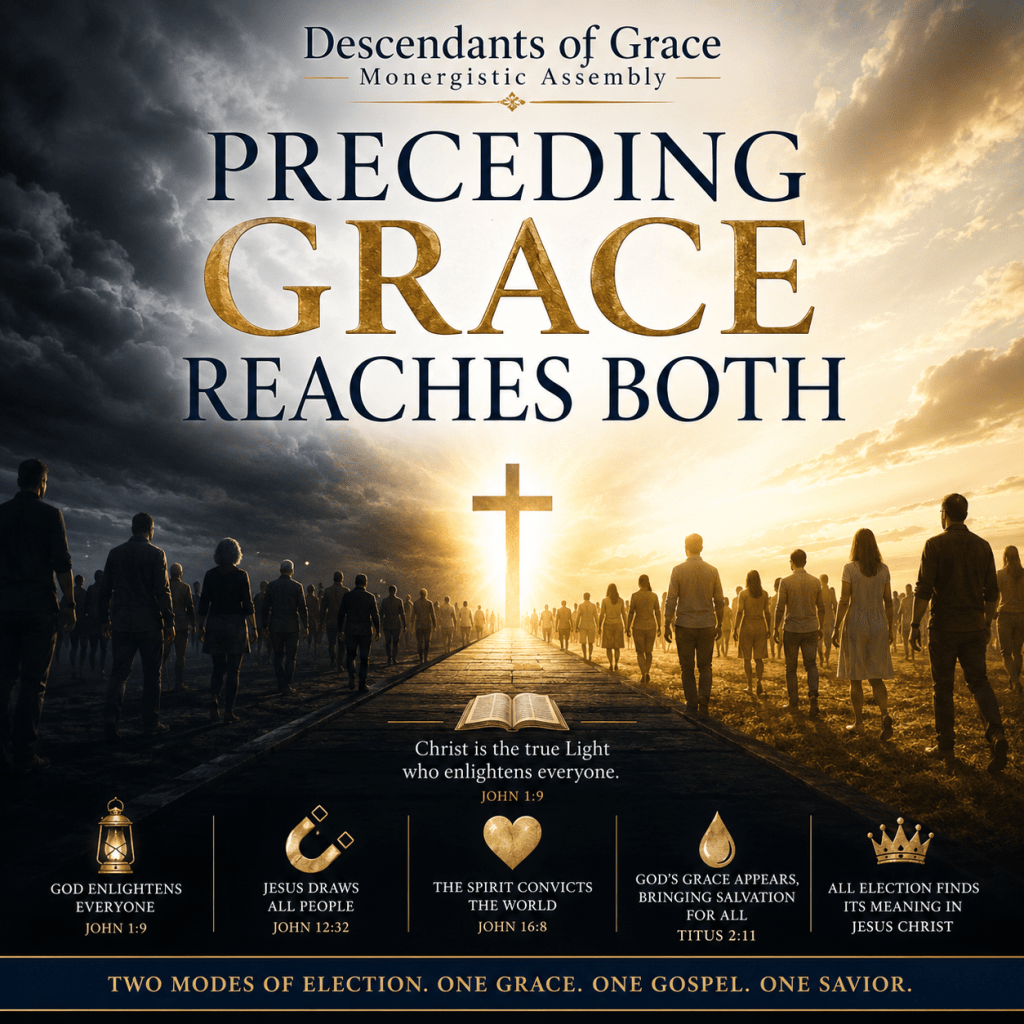
  • Preceding Grace Reaches Both: Two Modes of Election

    CLARE Theology does not teach that Preceding Grace belongs only to the Preceding Elect. Rather, Preceding Grace is God’s universal gracious activity toward fallen humanity, extending to both the Eternal Elect and the non-Eternal Elect. Before anyone seeks God, God has already acted.

    Scripture repeatedly speaks of this gracious activity in universal terms. Christ is the true Light who “enlightens everyone” (John 1:9). Jesus declares that He will draw all people to Himself (John 12:32). The Holy Spirit convicts the world (John 16:8), and the grace of God has appeared, bringing salvation for all people (Titus 2:11). These universal passages matter because they describe a grace that genuinely reaches humanity rather than one restricted only to those whom God eternally elected before creation.

    The Eternal Elect therefore receive Preceding Grace just as the rest of humanity does. They may genuinely resist God for a time. They may suppress the truth, cling to sin, reject conviction, and resist God’s gracious activity. Yet because God has eternally purposed their salvation in Christ, their resistance will not ultimately prevail. God’s saving purpose will irresistibly overcome their resistance and bring them to Christ.

    The non-Eternal Elect also genuinely receive Preceding Grace. Because grace has already preceded them, they do not remain in what CLARE calls Hypothetical Total Depravity. Instead, they exist in Enabled Depravity: still fallen, still sinful, still entirely dependent on grace, yet possessing a genuine, grace-enabled ability to resist or receive Christ. Those who respond in faith do not elect, regenerate, or save themselves. Grace has preceded every movement toward God. Through faith, they are united to Jesus Christ, the Elect One, and therefore become elect in Him. CLARE calls them the Preceding Elect.

    Thus, CLARE affirms two modes of election without proposing two ways of salvation. God’s sovereign Eternal Election is real, and Scripture’s universal language of divine drawing, illumination, conviction, and grace remains genuinely universal. Two modes of election. One grace. One Gospel. One Savior. All election ultimately finds its meaning in Jesus Christ.

    Paul offers a powerful biblical picture of how genuine resistance to God can persist even in someone eternally chosen by Him.

    Before the Damascus Road, Paul fiercely opposed Christ. He persecuted believers, ravaged the Church, and later described himself as a “blasphemer, persecutor, and insolent opponent” (1 Timothy 1:13; Acts 8:3). Yet Paul’s resistance did not mean God was absent from His story. His persecution put him in direct conflict with Christ and His people until Christ personally confronted him on the road to Damascus.

    Paul illustrates an important distinction within CLARE Theology: the Eternal Elect may genuinely resist grace, but they cannot resist God’s eternal saving purpose forever. Paul resisted Christ, yet God had purposed to bring Paul to Christ. When that appointed moment came, Christ confronted him. His resistance was overcome, and the persecutor became a disciple.

    This same principle of preceding grace extends universally, though its operation does not culminate in the same way for everyone. God acts first through revelation, illumination, conviction, drawing, and the proclamation of the Gospel. Humanity does not begin in spiritual neutrality or independently generate the first movement toward God. Grace precedes.

    Yet we resist.

    We suppress the truth. We delay. We cling to sin. We prefer darkness. We resist conviction. Yet God continues to act graciously toward fallen humanity.

  • The CLARE Theology System

    C — Christocentric Election

    Everything begins with Christ.

    Election is not first an abstract decree concerning individuals.

    Election is first rooted in the Father’s eternal purpose in His Son.

    Christ is the Elect One.

    The Eternal Elect are chosen in Christ before the foundation of the world.

    The Preceding Elect become elect through union with Christ.

    Thus both modes of election find their origin and fulfillment in Christ.

    Without Christ there is no election.

    Scripture

    Old Testament

    • Isaiah 42:1 — “Behold My Servant, whom I uphold; My Chosen One in whom My soul delights; I have put My Spirit upon Him…”

    New Testament

    • Ephesians 1:3–4 — “…He chose us in Him before the foundation of the world…”
    • 1 Peter 2:4–6 — Christ is the living Stone, chosen by God, and believers become God’s spiritual house through union with Him.

    L — Limitless Atonement

    Because Christ is the Savior of the world, His atoning work possesses universal sufficiency.

    His atonement is not merely enough to save.

    It also becomes the historical basis upon which God’s universal gracious activity toward humanity is established.

    Limitless Atonement therefore becomes the objective foundation of Preceding Grace.

    Without Christ’s atonement there is no universal drawing.

    Without Christ’s atonement there is no universal illumination.

    Without Christ’s atonement there is no universal conviction.

    Scripture

    Old Testament

    • Isaiah 53:6 — “All we like sheep have gone astray… and the LORD has laid on Him the iniquity of us all.”

    New Testament

    • John 12:32 — “And I, when I am lifted up from the earth, will draw all people to Myself.“
    • 1 John 2:2 — “He Himself is the propitiation for our sins, and not for ours only but also for the sins of the whole world.”

    A — Anthropology of Enabled Depravity

    This doctrine contains two inseparable components.

    Hypothetical Total Depravity

    Humanity considered apart from Christ’s gracious intervention.

    This is humanity if:

    • Christ had not entered history.
    • Grace had not appeared.
    • The Spirit did not convict.
    • The Gospel was never proclaimed.

    That condition is truly Total Depravity.

    CLARE calls it Hypothetical because Scripture never encounters humanity in redemptive history apart from God’s gracious initiative after Christ’s coming.

    Enabled Depravity

    Because Christ has entered history…

    Because His atonement has been accomplished…

    Because Preceding Grace is universally extended…

    Humanity’s actual condition is no longer one of untouched Total Depravity.

    Humanity remains:

    • Fallen
    • Spiritually ruined
    • Unable to save itself
    • Entirely dependent upon grace

    Yet humanity is simultaneously:

    • Illuminated
    • Convicted
    • Drawn
    • Called
    • Enabled

    This becomes the actual anthropology of humanity in redemptive history.

    Scripture

    Old Testament

    • Ezekiel 36:26–27 — God promises to give a new heart and put His Spirit within His people, demonstrating divine initiative in overcoming human inability.

    New Testament

    • John 1:9 — “The true Light, which gives light to everyone, was coming into the world.”
    • Titus 2:11 — “For the grace of God has appeared, bringing salvation to all people.”

    R — Resistible and Irresistible Grace

    Now the system naturally branches into two operations of grace.

    Irresistible Grace

    Toward the Eternal Elect.

    Those whom the Father has given to the Son are effectually called.

    God’s eternal decree cannot fail.

    Resistible Preceding Grace and Irresistible Saving Grace

    Toward all humanity.

    Grace genuinely precedes every movement toward God.

    Grace enables.

    Grace convicts.

    Grace draws.

    Grace never grants autonomous free will.

    Grace enables the fallen will.

    Those who are not Eternally Elect may resist that gracious work or surrender to Christ through repentance and faith.

    This is why CLARE intentionally rejects both:

    • traditional prevenient grace (because it is often tied to libertarian freedom), and
    • Calvinistic common grace (because it does not adequately explain the universal saving-oriented texts foundational to CLARE.

    Scripture

    Old Testament

    • Isaiah 65:2 — “I spread out My hands all the day to a rebellious people…”

    New Testament

    • John 6:37 — “All that the Father gives Me will come to Me…” (Irresistible Saving Grace toward the Eternal Elect.)
    • Acts 7:51 — “You always resist the Holy Spirit…” (Resistible Preceding Grace.)

    E — Enduring Security

    Finally, both modes of election converge.

    Whether one belongs to the Eternal Elect or becomes one of the Preceding Elect through union with Christ,

    both are now united to the same Savior.

    Both stand in the same grace.

    Both are justified by the same blood.

    Both are preserved by the same Lord.

    Both inherit the same promises.

    Both endure because Christ keeps them.

    Security is therefore grounded not in the mode of election but in union with Christ.

    Scripture

    Old Testament

    • Isaiah 54:10 — “Though the mountains depart… My steadfast love shall not depart from you, and My covenant of peace shall not be removed.”

    New Testament

    • John 10:27–29 — “My sheep hear My voice… no one will snatch them out of My hand.”
    • 1 Peter 1:3–5 — Believers “are being guarded by the power of God through faith for a salvation ready to be revealed in the last time.”

    Why these verses fit the CLARE framework

    These passages also reveal a progressive theological movement through Scripture:

    1. C — Christocentric Election: Christ is the Father’s Chosen One, and all election is grounded in union with Him (Isa. 42:1; Eph. 1:4; 1 Pet. 2:4–6).
    2. L — Limitless Atonement: Christ’s cross provides the universal redemptive foundation from which God’s drawing, illumination, and conviction extend to humanity (Isa. 53:6; John 12:32; 1 John 2:2).
    3. A — Anthropology of Enabled Depravity: Humanity remains radically fallen, yet because Christ has entered history, the light of Christ shines on all and God’s grace has appeared, enabling genuine response while preserving dependence on grace (Ezek. 36:26–27; John 1:9; Titus 2:11).
    4. R — Resistible and Irresistible Grace: Scripture presents both God’s effectual calling of those given to Christ and humanity’s real resistance to God’s gracious overtures (Isa. 65:2; John 6:37; Acts 7:51).
    5. E — Enduring Security: Once united to Christ, every believer—whether viewed through Eternal Election or Preceding Election—shares the same covenant promises, divine preservation, and everlasting security in Him (Isa. 54:10; John 10:27–29; 1 Pet. 1:3–5).
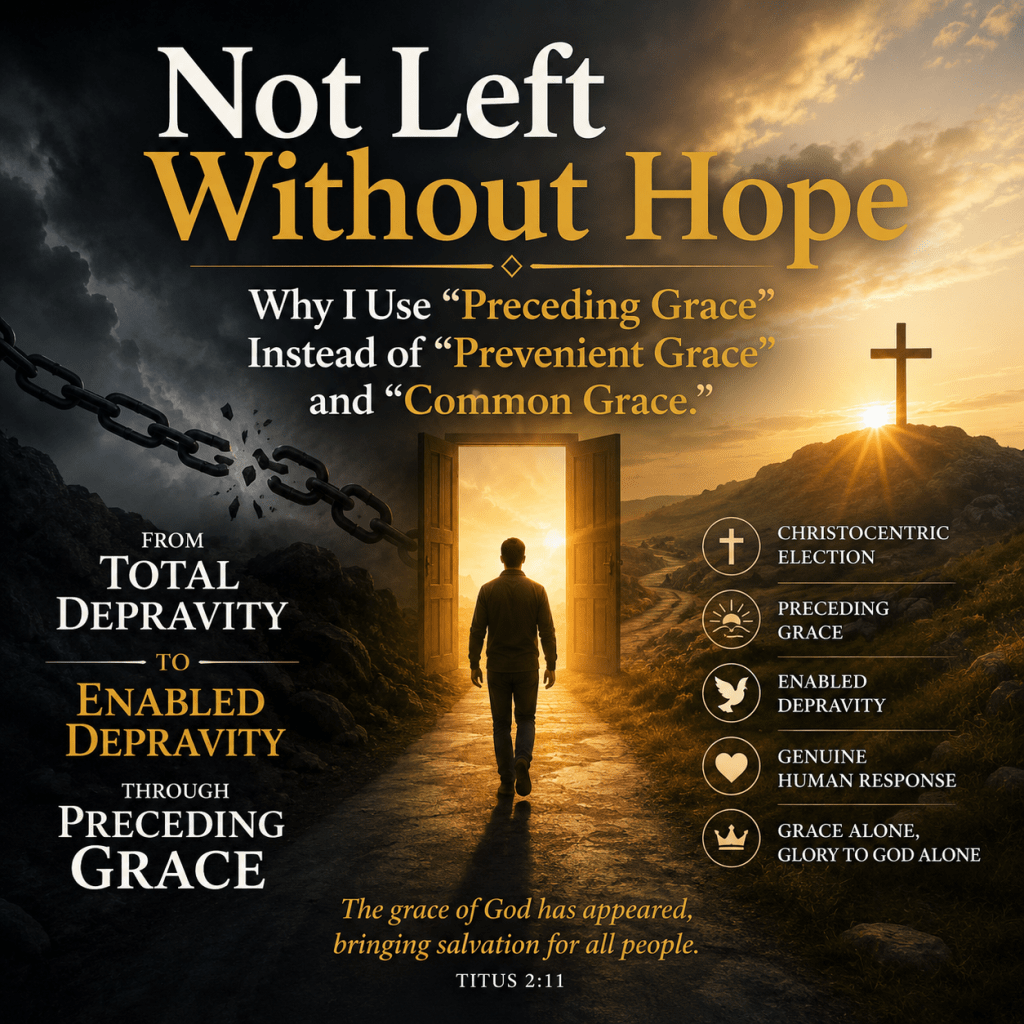
  • CLARE Theology: Not Left Without Hope: Why I Use “Preceding Grace” Instead of “Prevenient Grace” and “Common Grace.”

    I use the term Preceding Grace because words shape doctrine, and doctrine shapes devotion. When I speak about the Grace that comes before repentance and faith, I want the emphasis to fall on God’s action, not on human autonomy. Jesus says, “No one can come to me unless the Father who sent me draws him,” and yet He also says, “when I am lifted up from the earth, I will draw all people to myself” (John 6:44; 12:32, ESV). For me, those two texts already tell the story: Grace is prior, Grace is Christ-centered, and Grace is not a reward for the sinner’s first movement. 

    I do not reject the historical concern behind the older term ‘prevenient grace’. In fact, the Christian tradition has long confessed that Grace comes first. Augustine argues that there is “no merit in men’s choice of Christ” unless God’s Grace was already there before that choosing. Aquinas later explains that Grace is called prevenient because it causes earlier effects in us before later ones. John Wesley, in turn, speaks of “preventing grace,” the older English way of saying Grace that goes before. So my preference for Preceding Grace is not a rejection of history. It is an attempt at pastoral clarity. 

    “God’s grace was prevenient in His choosing them.”

    Reference: Augustine, On Grace and Free Will, ch. 38, AD 426/427. 

    The reason I do not simply keep the term prevenient Grace is that, in many modern ears, it sounds as if Grace merely restores to man a decisive, self-determining freedom that finally makes the sinner the ultimate cause of coming to Christ. Yet I do not believe fallen man comes to Christ by autonomous free will. I appreciate the historic insistence that Grace comes first. I do not affirm that the sinner, once “enabled,” becomes an independent spiritual first cause. Even within Wesleyan usage, prevenient Grace is often described as enabling those who will respond, and Wesley himself famously speaks of a “measure of free-will” restored by Grace. My concern is that many readers hear that language and interpret it as autonomy. I want a term that keeps their eyes on divine initiative. 

    At the same time, I want to say something else clearly: the Calvinist doctrine of Total Depravity is not wrong if we are speaking about what fallen human nature is in itself. Paul says, “None is righteous, no, not one,” “no one seeks for God,” and “all have sinned and fall short of the glory of God” (Rom. 3:10–12, 23, ESV). He says we were “dead in the trespasses and sins” (Eph. 2:1, ESV). Jesus says the sinner is “a slave to sin” (John 8:34, ESV), and Paul adds that the mind set on the flesh “does not submit to God’s law; indeed, it cannot,” and that those in the flesh “cannot please God” (Rom. 8:7–8, ESV). That is why I am fully willing to say that Total Depravity is ontologically true of fallen humanity. 

    But that is not the end of the matter. My claim is that Preceding Grace modifies the condition of fallen humanity from hypothetical Total Depravity to actual Enabled Depravity. Why do I say that? Because Scripture also says that Christ is “the true light, which gives light to everyone” (John 1:9, ESV); that when He is lifted up He will “draw all people” to Himself (John 12:32, ESV); that “the grace of God has appeared, bringing salvation for all people” (Titus 2:11, ESV); that God “desires all people to be saved and to come to the knowledge of the truth” (1 Tim. 2:4, ESV); that the Spirit will “convict the world” (John 16:8, ESV); and that God’s kindness is “meant to lead” sinners “to repentance” (Rom. 2:4, ESV). These texts do not teach that all are saved. They do teach that fallen humanity is not left in a bare state of unaddressed ruin. Humanity is met, confronted, illumined, drawn, and convicted by God. 

    This is why I use the term ” Enabled Depravity.” Humanity remains depraved. Humanity does not become neutral. Humanity does not become naturally free. Humanity does not become spiritually autonomous. But because of God’s prior Grace in Christ, humanity is no longer merely considered in abstraction as if humanity existed outside the reach of divine drawing. In other words, while humanity is fallen and incapable of saving itself, we should not describe humanity as though God has left humanity entirely to its fallen condition. Because Christ has entered history and extends “Preceding Grace,” or the Grace that preceded it, humanity now exists under a real divine drawing that enables a genuine response to the gospel. In that sense, Total Depravity is hypothetical in present experience. It tells the truth about what fallen nature is apart from Grace; yet because Preceding Grace is already operative in the world, the actual condition of humanity is better described, in this framework, as Enabled Depravity. 

    John Wesley comes surprisingly close to this point when he says there is no man now in a “state of mere nature.” That statement is extremely important for me. It means we should not describe the present human condition as if God had left the race wholly untouched after the fall. The sinner remains ruined in Adam, yes. But the sinner also stands beneath the prior activity of Christ’s light, Christ’s drawing, God’s kindness, and the Spirit’s conviction. Enabled Depravity, therefore, is not a denial of ruin. It is a description of ruined humanity under preceding Grace. 

    “There is no man that is in a state of mere nature.”

    Reference: John Wesley, On Working Out Our Own Salvation, Sermon 85, Sept.–Oct. 1785. 

    This also explains why I reject libertarian free will. By that phrase, I mean the idea that the decisive power of contrary choice finally lies in the autonomous self. I do not believe Scripture teaches that. Jesus says no one can come unless drawn (John 6:44). Lydia believed because “the Lord opened her heart” (Acts 16:14, ESV). Paul says, “because of him you are in Christ Jesus” (1 Cor. 1:30, ESV), and Ephesians says salvation is “not your own doing” (Eph. 2:8, ESV). Yet Scripture also says, “you always resist the Holy Spirit” (Acts 7:51, ESV). So the response of man is real, but it is never autonomous. The sinner does not come to Christ by self-originated freedom; he comes because God precedes him with Grace and enables his response without ceasing to be God. 

    At this point, I need to distinguish Preceding Grace from Calvinistic Common Grace. I do not deny the truth that Reformed theology is trying to protect there. Scripture plainly teaches that God “makes his sun rise on the evil and on the good” (Matt. 5:45, ESV), and that He gives “rains from heaven and fruitful seasons,” filling human hearts “with food and gladness” (Acts 14:17, ESV). Reformed writers rightly use the term “common Grace” for God’s universal providential goodness, restraint of evil, and preservation of a fallen world. Kuyper’s great contribution was to insist that the world is not less sinful because man is less corrupt, but because God curbs the outworking of sin. 

    “He curbs the operations of Satan, death, and sin.”

    Reference: Abraham Kuyper, Principles of Sacred Theology, as quoted in The Goodness of God and Common Grace; Kuyper (1837–1920). 

    But my point is that Preceding Grace is not exhausted by that category. Common Grace, in Reformed usage, represents non-saving favor and restraint. Preceding Grace, as I use it, points to a more explicitly Christological and redemptive direction: illumination, drawing, conviction, witness, and gracious enablement toward repentance and faith. Herman Bavinck is helpful here because he links Christ the Logos, common witness, and the broader theater in which Grace addresses humanity. That does not mean Bavinck meant CLARE by that language. It does mean the path is not unnatural. 

    “he enlightens every human coming into the world.”

    Reference: Herman Bavinck, Reformed Dogmatics, vol. 4, ch. 1; cited excerpt from Monergism; Bavinck (1854–1921). 

    This is also where I introduce the CLARE distinction between the Eternal Elect and the Preceding Elect. This distinction flows directly from Christocentric Election, Enabled Depravity, and Preceding Grace.

    By the Eternal Elect, I mean those spoken of in Ephesians 1:4, where God “chose us in him before the foundation of the world” (ESV). I also hear that note in John 6:37, where Jesus says, “All that the Father gives me will come to me” (ESV). This is Election in its eternal and divine origin. These are those whom God chose in Christ before creation and whom He irresistibly brings to saving faith according to His eternal purpose.

    The Eternal Elect are therefore not merely invited to Christ; they are effectually and infallibly brought into union with Him. Their salvation rests upon God’s eternal decree and cannot ultimately fail because God Himself ensures their coming.

    But CLARE Theology does not stop there.

    Classical Calvinism often divides humanity into two ultimate groups: the Elect and the Reprobate. The Elect are irresistibly brought to salvation. The Reprobate remain in Total Depravity and therefore cannot positively respond to God because they are never given saving Grace. In that framework, those who are not eternally elected possess no genuine hope of salvation.

    CLARE Theology takes a different approach.

    While affirming Eternal Election, CLARE rejects the conclusion that all who are not Eternally Elect are therefore hopelessly reprobate. Christ’s atonement was sufficient for the entire world. God’s Preceding Grace extends universally. Christ is the true light who “gives light to everyone” (John 1:9, ESV). He draws “all people” to Himself (John 12:32, ESV). The Grace of God has appeared “bringing salvation for all people” (Titus 2:11, ESV). The Spirit convicts “the world” (John 16:8, ESV).

    For this reason, humanity is not divided between the Eternally Elect and the hopelessly abandoned. Humanity exists under Enabled Depravity.

    This means that while fallen humanity remains incapable of saving itself, God has not left humanity in a condition where response to Him is impossible. Christ’s atonement and God’s Preceding Grace modify the lived condition of fallen humanity from hypothetical Total Depravity to actual Enabled Depravity.

    The sinner remains ruined.

    The sinner remains dependent.

    The sinner remains incapable of self-salvation.

    Yet the sinner is not abandoned.

    The sinner is illumined, confronted, convicted, drawn, and enabled through God’s gracious action in Christ.

    This is where the doctrine of the Preceding Elect emerges.

    By the Preceding Elect, I do not mean people who make themselves elect through autonomous free will. Nor do I mean that sinners independently choose God apart from Grace. Rather, I mean those who, though not chosen as individuals in Eternal Election, are nevertheless enabled by God’s Preceding Grace through Christ’s sufficient atonement and, within the condition of Enabled Depravity, come to repentance and faith, thereby becoming elect through union with Christ, the Elect One.

    The Preceding Elect become Elect because they become united to Christ.

    Their Election is not grounded in autonomous willing.

    Their Election is not grounded in self-generated faith.

    Their Election is not grounded in personal merit.

    Their Election is grounded in Christ.

    Paul repeatedly speaks this way.

    “Because of him you are in Christ Jesus” (1 Cor. 1:30, ESV).

    Believers are sons of God “through faith” in Christ Jesus and become Abraham’s offspring because they belong to Christ (Gal. 3:26–29, ESV).

    Likewise, Paul speaks of salvation occurring “through sanctification by the Spirit and belief in the truth” and through God’s call in the gospel (2 Thess. 2:13–14, ESV).

    The pattern is significant.

    God acts first.

    Grace precedes.

    The Spirit convicts.

    Christ draws.

    The gospel calls.

    Faith responds.

    Union with Christ follows.

    Election is realized in Christ.

    The Preceding Elect therefore do not become Elect because they possessed libertarian free will. They become Elect because God’s Grace made their response possible.

    At this point, an analogy may be helpful.

    Imagine two men trapped in a burning building.

    The first is carried out by a firefighter who determined beforehand that he would certainly rescue him. The firefighter reaches him, lifts him from the flames, and ensures his rescue. This resembles the Eternal Elect.

    The second man is also reached by the firefighter. He is awakened from sleep. He is shown the path of escape. He is repeatedly urged to follow. He does not extinguish the fire. He does not create the exit. He does not rescue himself. Every possibility of survival depends entirely upon the firefighter’s intervention. Yet he may either follow the rescuer or resist the rescue. If he follows, his salvation remains entirely dependent upon the rescuer’s action. This resembles the Preceding Elect.

    In both cases, the rescuer receives the glory.

    In neither case does the victim save himself.

    Or consider another analogy.

    Imagine a dark room.

    Eternal Election is like a blind man’s eyes being infallibly opened so that he certainly sees the light.

    Preceding Grace is like the light entering the room itself. The light makes sight possible. Those who see do so because of the light. They did not create vision. They did not create illumination. The light came first.

    Some look toward the light.

    Others shut their eyes against it.

    Yet in both cases, sight was possible only because light entered the room.

    Likewise, salvation is only possible because Christ first enters the darkness of the human condition.

    This distinction allows me to preserve what I believe Scripture preserves.

    Election is never severed from Christ.

    Election is never grounded in autonomous human willing.

    Election is never reduced to philosophical determinism.

    The Eternal Elect speaks of God’s eternal purpose in Christ.

    The Preceding Elect speaks of the historical and redemptive way God’s Grace reaches persons through illumination, conviction, drawing, and enablement.

    Both categories find their meaning in Christ.

    The Eternal Elect are chosen in Christ from eternity and irresistibly brought into union with Him.

    The Preceding Elect become Elect through union with Christ by means of God’s Preceding Grace operating within Enabled Depravity.

    In both cases, Christ is the ground of Election, Grace is the cause of salvation, and boasting is excluded.

    Here, I also find early Christian witnesses helpful.

    Justin Martyr speaks of the Logos as present among humanity, and Irenaeus describes salvation through the incarnate Word as humanity’s entry into adoption. Those voices do not erase important doctrinal differences across the centuries. Still, they reinforce an important instinct: the story of salvation begins with God’s prior movement toward us in His Word and Son, not with the sinner’s autonomous decision.

    “The seed of reason [the Logos] implanted in every race of men.”

    Reference: Justin Martyr, Second Apology, ch. 8; Justin Martyr (c. 100–c. 165).

    Recommended Reading

    Augustine, On Grace and Free Will — still one of the clearest early Christian statements that Grace does not destroy will, yet precedes and enables all good willing. 

    Thomas Aquinas, Summa Theologiae, I–II, q. 109 and q. 111 — essential for the classical distinction between Grace as inward divine help, and for the formal language of prevenient and subsequent Grace. 

    John Wesley, “On Working Out Our Own Salvation” — crucial for the older English language of “preventing grace,” for the denial of bare natural ability, and for the claim that no one now exists in a merely natural condition untouched by Grace. 

    Abraham Kuyper, Common Grace: God’s Gifts for a Fallen World, vol. 1 — useful not because it says the same thing as CLARE, but because it gives the strongest Reformed account of Grace as restraint and preservation, which your article needs to distinguish from Preceding Grace. 

    Herman Bavinck, Reformed Dogmatics, vol. 4, ch. 1 — especially valuable for connecting Christ as Logos, divine witness in creation and history, and the broader theater in which the gospel call appears. 

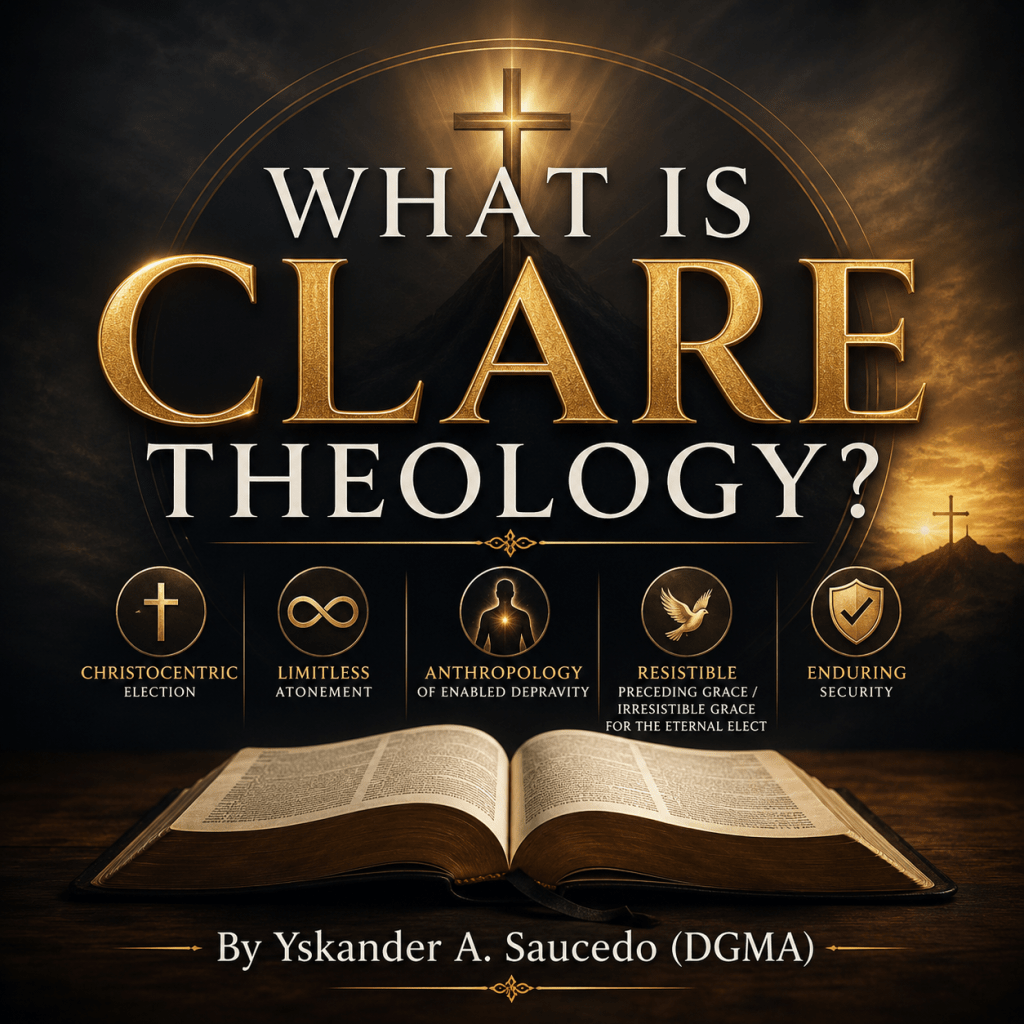
  • What Is CLARE Theology?

    What Is CLARE Theology?

    By Yskander A. Saucedo (DGMA)

    Founder and Director of Descendants of Grace Monergistic Assembly

    And DGMA.Doctrine Productions

    Christian theology has long wrestled with difficult questions concerning grace, election, free will, sovereignty, and salvation. Across church history, believers have often found themselves divided between theological systems that emphasize either God’s sovereignty or man’s responsibility. Yet Scripture consistently presents both realities together under the supremacy of Christ.

    CLARE Theology was developed as an attempt to articulate a Christ-centered, monergistic framework that seeks to preserve the fullness of biblical revelation without forcing Scripture into categories that may oversimplify the mystery of God’s redemptive work.

    CLARE stands for:

    • C — Christocentric Election
    • L — Limitless Atonement
    • A — Anthropology of Enabled Depravity
    • R — Resistible Preceding Grace / Irresistible Grace for the Eternal Elect
    • E — Enduring Security

    At its core, CLARE Theology insists that salvation begins, continues, and ends in Christ.


    Christ at the Center

    Many theological systems begin primarily with man’s condition or with abstract decrees concerning predestination. CLARE Theology begins with Christ Himself.

    The apostle Paul writes:

    “He chose us in him before the foundation of the world, that we should be holy and blameless before him.” — Ephesians 1:4 (ESV)

    Election is not viewed merely as an isolated decree detached from Christ, but as something eternally centered in Him. Christ is not secondary to election — Christ is the foundation, purpose, and fulfillment of election.

    This Christ-centered emphasis echoes the language of early church fathers such as Irenaeus of Lyons, who frequently emphasized that all of salvation history is summed up and recapitulated in Christ. In Against Heresies, Irenaeus wrote that Christ “became what we are, that He might bring us to be even what He is Himself.” This Christological focus remains foundational to CLARE Theology.


    Why CLARE Was Developed

    CLARE Theology emerged from the conviction that certain theological debates have often created false dilemmas.

    For example:

    • Must grace always be irresistible?
    • Does human responsibility require autonomous free will?
    • Must atonement be either entirely limited or universally saving?
    • Can God sovereignly know all contingent outcomes without surrendering His sovereignty?

    CLARE seeks to address these tensions by maintaining that God’s sovereignty and genuine human accountability coexist under divine providence.

    Scripture repeatedly affirms both truths simultaneously.

    Jesus declared:

    “All that the Father gives me will come to me, and whoever comes to me I will never cast out.” — John 6:37 (ESV)

    Yet Scripture also warns humanity against resisting God:

    “You stiff-necked people… you always resist the Holy Spirit.” — Acts 7:51 (ESV)

    Rather than dismissing one text in favor of another, CLARE Theology seeks to preserve the total witness of Scripture.


    Anthropology of Enabled Depravity

    One of the most distinct aspects of CLARE Theology is the doctrine of Enabled Depravity.

    CLARE affirms humanity’s radical corruption through sin. Humanity is fallen, spiritually dead apart from God, and utterly dependent upon divine grace. However, CLARE also teaches that because of Christ’s redemptive work in history, humanity does not exist in a state of absolute abandonment from divine influence.

    As Jesus declared:

    “And I, when I am lifted up from the earth, will draw all people to myself.” — John 12:32 (ESV)

    This drawing does not guarantee salvation for every individual, but it does affirm the universal activity of God’s grace through Christ in history.

    Unlike libertarian concepts of “free will,” CLARE Theology maintains that human beings are enabled by grace but never possess absolute autonomous freedom. God alone possesses true and absolute free will.

    This concern reflects ideas seen in Augustine of Hippo, who argued that fallen humanity cannot return to God apart from grace. Augustine famously wrote:

    “Man’s will is not free without God’s grace.”

    CLARE Theology agrees with Augustine regarding humanity’s dependence upon grace while further emphasizing the universal historical implications of Christ’s redemptive work.


    A Christ-Centered Monergism

    CLARE Theology is monergistic in the sense that salvation originates in God alone. Grace precedes all human response. God is always the initiator of salvation.

    As Scripture teaches:

    “We love because he first loved us.” — 1 John 4:19 (ESV)

    Yet CLARE also recognizes biblical passages showing humanity resisting divine conviction and revelation. Therefore, CLARE distinguishes between:

    • God’s universal preceding grace,
    • and God’s irresistible saving work toward the eternal elect.

    This framework seeks to uphold both God’s sovereignty and the sincerity of the gospel call to the world.


    The Purpose of CLARE Theology

    CLARE Theology is not an attempt to create theological novelty for its own sake. Its goal is to exalt Christ, defend the authority of Scripture, encourage serious theological reflection, and proclaim the gospel with clarity.

    The ultimate purpose is not merely to win doctrinal arguments, but to direct people toward Christ Himself.

    As the apostle Paul declared:

    “For from him and through him and to him are all things. To him be glory forever. Amen.” — Romans 11:36 (ESV)

    Theology that does not lead to worship ultimately fails its purpose.

    CLARE Theology exists to proclaim:
    Christ above systems. Christ above pride. Christ over everything.

  • Jesus gave a warning in Matthew 7:15: “Beware of false prophets who come to you in sheep’s clothing but inwardly are ravenous wolves.” A few weeks ago, we completed our lessons in early church heresies. Most of the heresies revolved around the deity of Christ and His ontological existence (Trinity). Some heretics were Christians attempting to reconcile how to maintain monotheism (worship of one God) while at the same time worshiping Jesus Christ as the Son of God, while worshiping God the Father, and not seem like polytheists (worship of multiple gods). Consequently, some of the heresies that emerged were Arianism, which holds that Jesus is a created being. Modalism, which is the belief that the Father, Son, and Holy Spirit are not three persons, but are all mere titles and modes of expressions used by God to express himself to humans at different times. Tritheism, which is the belief that the Father, Son, and Holy Spirit are not three co-equal and eternal persons as one God or substance but are three separate gods instead of one. There are several more heresies regarding the belief in the Godhead and the being of Jesus Christ but were all settled in great debate through church councils. One of those debates is the Council of Nicaea which confirmed that the Son of God was never created and existed through all eternity one and the same substance as the Father. Beliefs such as Arianism were judged according to scripture and condemned as heresy. Although these heresies have been tried and condemned by God’s providence and sovereignty. Sovereignty meaning God’s absolute authority to rule over all His creation, and providence meaning how God actively applies His sovereignty over all His creation. Some of these early heresies have not disappeared but the demonic forces in this world have found their application in the false religions of our day. Currently in our men’s meetings on Tuesday evenings we are studying these false religions and learning their false doctrines in contrast to the truth of God in His Word. Precept against precept. Doctrine against doctrine. Our true God verses their false gods. For example, we have encountered how the Seventh Day Advantest are still trusting in their works as they earn their way to heaven in a doctrine known as the “Investigative Judgement.” Where the death and resurrection of Jesus was not enough to atone for the sins of the world and Jesus is currently at a higher state of heaven reviewing the lives of professed “Christians” for their authenticity of their repentance. In other words, the Grace of God and our Faith in Christ is not enough. Arianism has crept its way into Jehovah’s Witness doctrine as they believe Jesus was the created Michael the Archangel before coming to earth. Tritheism or Polytheism has crept its way into Mormonism as they are taught there are multiple gods and we ourselves may become a god after death and perhaps given our own planet to rule as god. Finally, my brothers and sisters. I leave you with 1Timothy 4:1 “Now the Spirit expressly says that in latter times some will depart from the faith, giving heed to deceiving spirits and doctrines of demons.”  Study the Word of God and sound biblical doctrine earnestly.