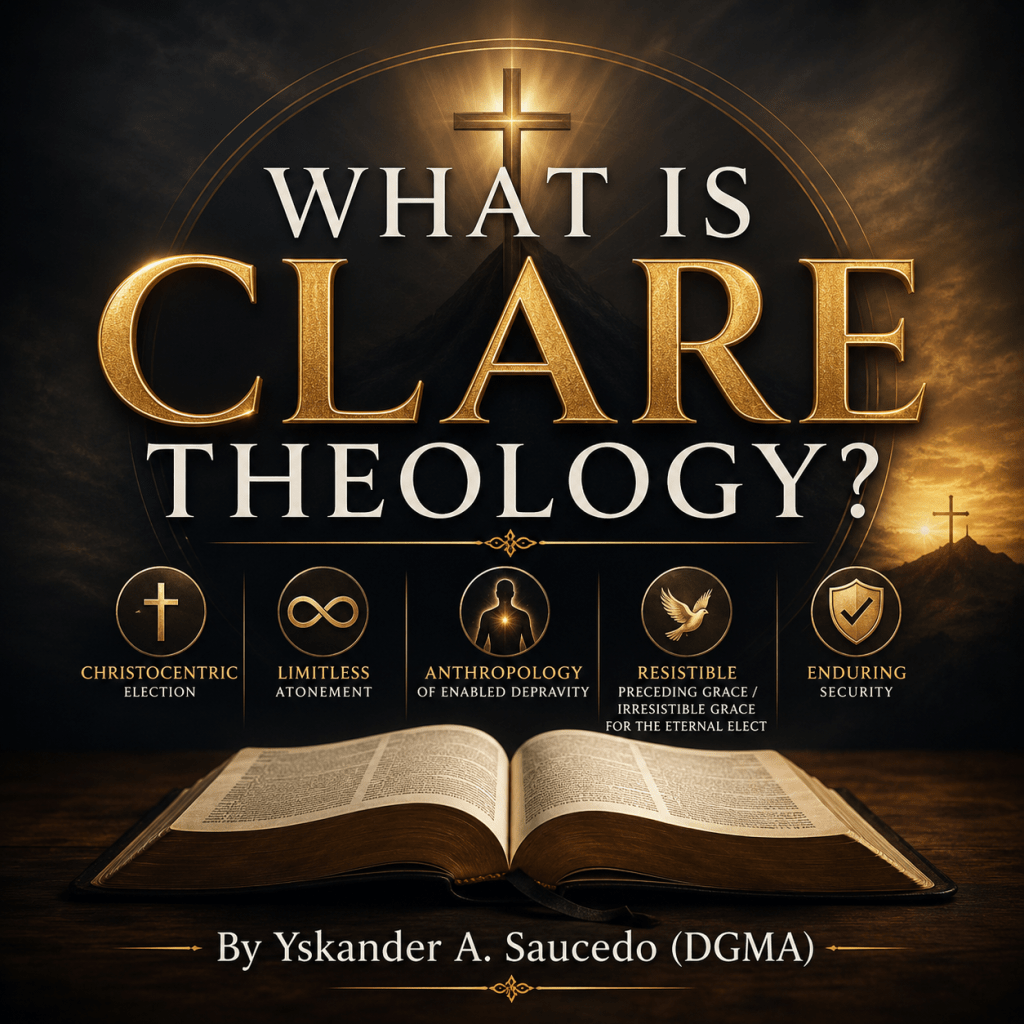
What Is CLARE Theology?
By Yskander A. Saucedo (DGMA)
Founder and Director of Descendants of Grace Monergistic Assembly
And DGMA.Doctrine Productions
Christian theology has long wrestled with difficult questions concerning grace, election, free will, sovereignty, and salvation. Across church history, believers have often found themselves divided between theological systems that emphasize either God’s sovereignty or man’s responsibility. Yet Scripture consistently presents both realities together under the supremacy of Christ.
CLARE Theology was developed as an attempt to articulate a Christ-centered, monergistic framework that seeks to preserve the fullness of biblical revelation without forcing Scripture into categories that may oversimplify the mystery of God’s redemptive work.
CLARE stands for:
- C — Christocentric Election
- L — Limitless Atonement
- A — Anthropology of Enabled Depravity
- R — Resistible Preceding Grace / Irresistible Grace for the Eternal Elect
- E — Enduring Security
At its core, CLARE Theology insists that salvation begins, continues, and ends in Christ.
Christ at the Center
Many theological systems begin primarily with man’s condition or with abstract decrees concerning predestination. CLARE Theology begins with Christ Himself.
The apostle Paul writes:
“He chose us in him before the foundation of the world, that we should be holy and blameless before him.” — Ephesians 1:4 (ESV)
Election is not viewed merely as an isolated decree detached from Christ, but as something eternally centered in Him. Christ is not secondary to election — Christ is the foundation, purpose, and fulfillment of election.
This Christ-centered emphasis echoes the language of early church fathers such as Irenaeus of Lyons, who frequently emphasized that all of salvation history is summed up and recapitulated in Christ. In Against Heresies, Irenaeus wrote that Christ “became what we are, that He might bring us to be even what He is Himself.” This Christological focus remains foundational to CLARE Theology.
Why CLARE Was Developed
CLARE Theology emerged from the conviction that certain theological debates have often created false dilemmas.
For example:
- Must grace always be irresistible?
- Does human responsibility require autonomous free will?
- Must atonement be either entirely limited or universally saving?
- Can God sovereignly know all contingent outcomes without surrendering His sovereignty?
CLARE seeks to address these tensions by maintaining that God’s sovereignty and genuine human accountability coexist under divine providence.
Scripture repeatedly affirms both truths simultaneously.
Jesus declared:
“All that the Father gives me will come to me, and whoever comes to me I will never cast out.” — John 6:37 (ESV)
Yet Scripture also warns humanity against resisting God:
“You stiff-necked people… you always resist the Holy Spirit.” — Acts 7:51 (ESV)
Rather than dismissing one text in favor of another, CLARE Theology seeks to preserve the total witness of Scripture.
Anthropology of Enabled Depravity
One of the most distinct aspects of CLARE Theology is the doctrine of Enabled Depravity.
CLARE affirms humanity’s radical corruption through sin. Humanity is fallen, spiritually dead apart from God, and utterly dependent upon divine grace. However, CLARE also teaches that because of Christ’s redemptive work in history, humanity does not exist in a state of absolute abandonment from divine influence.
As Jesus declared:
“And I, when I am lifted up from the earth, will draw all people to myself.” — John 12:32 (ESV)
This drawing does not guarantee salvation for every individual, but it does affirm the universal activity of God’s grace through Christ in history.
Unlike libertarian concepts of “free will,” CLARE Theology maintains that human beings are enabled by grace but never possess absolute autonomous freedom. God alone possesses true and absolute free will.
This concern reflects ideas seen in Augustine of Hippo, who argued that fallen humanity cannot return to God apart from grace. Augustine famously wrote:
“Man’s will is not free without God’s grace.”
CLARE Theology agrees with Augustine regarding humanity’s dependence upon grace while further emphasizing the universal historical implications of Christ’s redemptive work.
A Christ-Centered Monergism
CLARE Theology is monergistic in the sense that salvation originates in God alone. Grace precedes all human response. God is always the initiator of salvation.
As Scripture teaches:
“We love because he first loved us.” — 1 John 4:19 (ESV)
Yet CLARE also recognizes biblical passages showing humanity resisting divine conviction and revelation. Therefore, CLARE distinguishes between:
- God’s universal preceding grace,
- and God’s irresistible saving work toward the eternal elect.
This framework seeks to uphold both God’s sovereignty and the sincerity of the gospel call to the world.
The Purpose of CLARE Theology
CLARE Theology is not an attempt to create theological novelty for its own sake. Its goal is to exalt Christ, defend the authority of Scripture, encourage serious theological reflection, and proclaim the gospel with clarity.
The ultimate purpose is not merely to win doctrinal arguments, but to direct people toward Christ Himself.
As the apostle Paul declared:
“For from him and through him and to him are all things. To him be glory forever. Amen.” — Romans 11:36 (ESV)
Theology that does not lead to worship ultimately fails its purpose.
CLARE Theology exists to proclaim:
Christ above systems. Christ above pride. Christ over everything.


