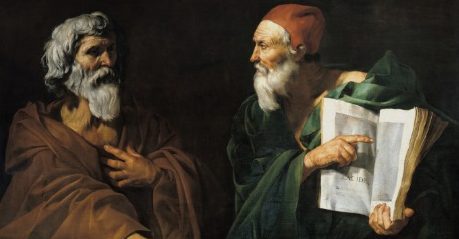

In common are the multiple ethical dilemmas humans find themselves in on a frequent basis. Conceptual moral factors are an anchor of weight one must struggle to deal with to determine what action is right or wrong. In determining the moral factor, some are arbitrary in deciding what course of action to take. In contrast, … Continue reading The Elenchus Experience Moral Relative Dilemma
Management Ethics: Business Ethics and Moral Character
It is ostensibly obvious that anytime currency is involved in a situation especially business in relation to earning money, unethical behavior will be revealed. Chapter one of Business Ethics begins with examples of white-collar executives who were sent to prison or companies bankrupt as a consequence of unethical behavior. From the investors, the one I … Continue reading Management Ethics: Business Ethics and Moral Character
The Enlightenments Supremacy Over the Divine Right of Kings Doctrine
Religion has evidently been a persuasive influence in civilization and government, particularly the historical monarchs. Speculation to this day leads to a debate about whether biblical law ought to be the standard of governments judicial system with doctrines such as Theonomy and Christian Reconstruction. Highly sophisticated arguments have been developed from proponents and advocates of … Continue reading The Enlightenments Supremacy Over the Divine Right of Kings Doctrine
The Pessimism of Schopenhauer
The pessimism of Schopenhauer is profoundly metaphysical. The world itself is will and the will of the world or the nature thereof is principally wicked. Evil exists in the world because the world itself is a manifestation of will. All humans have a will but the will of man is identified with the will of … Continue reading The Pessimism of Schopenhauer
The insubstantial Social Contract Theory
Social contract theory (SCT) is arguably the most influential theory for moral and political philosophy. Hobbes, Locke, and Rousseau are perhaps the most dominant political philosophers responsible for shaping the modern political theory of Europe and North America; nevertheless, SCT is not a newly developed concept. Examples of SCT are found throughout history since the … Continue reading The insubstantial Social Contract Theory
David Hume Perceptions
Empiricism is a posteriori, any knowledge is dependent upon the senses, observation, and experience, and apart from reason, but not necessarily being certain or justified knowledge other than any knowledge gained from induction. If there is any certainty that may have been gained through the history of philosophy is that not everyone knows everything, some … Continue reading David Hume Perceptions
Tears Fall Like The Rain
I lay in this place Secluded and dark My heart is in pain Tears fall like the rain These memories play Why can't they fade I lay in this place Secluded and dark I'm here by myself But never alone My voice wants to scream Wish this was a dream I lay in this place … Continue reading Tears Fall Like The Rain
Qualities of the Gospel
One of the greatest responsibilities a minister of God's word has is the ability to correctly interpret the scriptures, as well as reveal Christ through the scriptures while preaching the Gospel. Sunday after Sunday, people flock to the churches in hopes of hearing something that may help them in life. Regardless of the conditions and … Continue reading Qualities of the Gospel
St. Augustine’s Just War Theory
There are some who ask if there is any value in philosophy and if there is what may be a relevant example. Philosophy may be considered the cornerstone of the sciences. Before astronomy became a science; Thales of Miletus predicted an eclipse. When a philosophy gathers enough facts to become dogmatic, it becomes a science … Continue reading St. Augustine’s Just War Theory
The Meditations
Marcus Aurelius was a Stoic philosopher, and anyone who reads his book titled: Meditations, may agree he was a Stoic who lived trying to make Stoicism applicable in his life. He was born 121 A.D. and became a Roman Emperor in 161 A.D. until he died in 180 A.D. (Kamtekar). Understanding Marcus Aurelius’s philosophy and … Continue reading The Meditations
 Descendants of Grace Monergistic Assembly