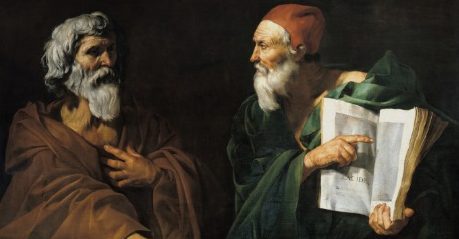
Empiricism is a posteriori, any knowledge is dependent upon the senses, observation, and experience, and apart from reason, but not necessarily being certain or justified knowledge other than any knowledge gained from induction. If there is any certainty that may have been gained through the history of philosophy is that not everyone knows everything, some … Continue reading David Hume Perceptions
Qualities of the Gospel
One of the greatest responsibilities a minister of God's word has is the ability to correctly interpret the scriptures, as well as reveal Christ through the scriptures while preaching the Gospel. Sunday after Sunday, people flock to the churches in hopes of hearing something that may help them in life. Regardless of the conditions and … Continue reading Qualities of the Gospel
St. Augustine’s Just War Theory
There are some who ask if there is any value in philosophy and if there is what may be a relevant example. Philosophy may be considered the cornerstone of the sciences. Before astronomy became a science; Thales of Miletus predicted an eclipse. When a philosophy gathers enough facts to become dogmatic, it becomes a science … Continue reading St. Augustine’s Just War Theory
The Meditations
Marcus Aurelius was a Stoic philosopher, and anyone who reads his book titled: Meditations, may agree he was a Stoic who lived trying to make Stoicism applicable in his life. He was born 121 A.D. and became a Roman Emperor in 161 A.D. until he died in 180 A.D. (Kamtekar). Understanding Marcus Aurelius’s philosophy and … Continue reading The Meditations
Soul or Body as a Substance or Accident
Someone recently asked me a great philosophical question. Here is my response: Since a substance is something that is in and of itself; instead of the example being a human, shouldn't the example be a little bit more specific like the human soul? Hello Frexxxxxx, Great question regarding the substance and the soul. I would say, … Continue reading Soul or Body as a Substance or Accident
God The Absolute Form
This weeks study of Plato’s Republic left me very intrigued about Plato’s theory of the forms. I found the theory slightly complexing and spent most of my study time trying to understand it. An intricate theory such as this will take much more hours of study and would be worth a well length research paper. … Continue reading God The Absolute Form
Socrates: Early Life and Death
During Socrates’s life, the city of Athens was enamored with beauty, especially in relation toward men. Manifestations of their infatuations were reflected in stone statues of gods and male humans. Often the statues were chiseled to represent a well-formed muscular image, which portrayed the standard for male development. Unfortunately for Socrates, he fell far from … Continue reading Socrates: Early Life and Death
Socrates Should He Have Escaped?
Interestingly, Crito began attempting to persuade Socrates to escape by considering what people may think if his friends did not come to his rescue. Socrates does a good job giving reasons why considering the opinions of the masses irrelevant; however, in true essence, it is relevant because Socrates still favors the opinion of a particular … Continue reading Socrates Should He Have Escaped?
Socrates, Just or Unjust Utility
In Euthyphro, what I realized the most from the dialogue is Socrates’ keen sense of logic. I’ll repeat again that I do not believe Socrates was sincere about being a student of Euthyphro, but merely used that as a reason to find mutual ground with Euthyphro; in order to engage in argument for the purpose … Continue reading Socrates, Just or Unjust Utility
Socrates the Rational Realist
In the Euthyphro, there were a couple of things that intrigued me about Socrates’s dialogue. The first is that Socrates noticed the justification of piety Euthyphro was using for prosecuting his father of murder. Euthyphro expressed that if anyone considered him impious for wanting to prosecute his father, then it reveals how little they know … Continue reading Socrates the Rational Realist
 Descendants of Grace Monergistic Assembly