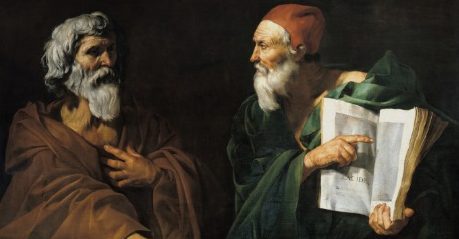
William Alexander Hernandez writes that St. Augustine believed two theories regarding the concept of time; that time is a creature of God and time is a phenomenon of human consciousness (p. 73). The two theories are derived from Augustine’s Confessions Book 11. The creature of time theory recognizes the concept of time having its origin … Continue reading Time and Ethics: A Short Essay of St. Augustine’s View from Confessions Book 11
Time: A Subjective Practical Illusion
During the lifespan of a human being, each one has a birth and a death, a beginning and an end. People generally acknowledge the day of their birth every year and reach closer to death every year. Not only do all men without exception have birth and death in common, but all men use a … Continue reading Time: A Subjective Practical Illusion
A Bibliographical Essay on Just War Theory
Introduction In this essay, I will examine two of the predominant Christian thinkers from the early developers of JWT. Three contemporary authors will also be examined as well such as; Jeff McMahan, Michael Walzer, and Michael Farrell. The intent is to discover credible sources and look for logical moral consistency throughout the works of several … Continue reading A Bibliographical Essay on Just War Theory
Animal Rights by Way of Contractarian Human Extension
Regan begins his argument by stating that the system which allows us to view animals as a resource is fundamentally wrong, (p.1). Viewing animals as a resource does not necessarily have to be perceived as something wrong. One may identify animals as a resource from a positive point of view. Regan seems to convey this … Continue reading Animal Rights by Way of Contractarian Human Extension
Experimental Philosophy
Experimental Philosophy (X-Phi) is a relatively new 21st-century approach. The approach is less traditional and more in common with modern methods used by the social sciences. Traditionally, philosophers would spend their leisure gathering data and performing experiments. Philosophers for over two thousand years have been comfortable performing thought experiments as they reflect their way to … Continue reading Experimental Philosophy
The Elenchus Experience Moral Relative Dilemma
In common are the multiple ethical dilemmas humans find themselves in on a frequent basis. Conceptual moral factors are an anchor of weight one must struggle to deal with to determine what action is right or wrong. In determining the moral factor, some are arbitrary in deciding what course of action to take. In contrast, … Continue reading The Elenchus Experience Moral Relative Dilemma
Management Ethics: Business Ethics and Moral Character
It is ostensibly obvious that anytime currency is involved in a situation especially business in relation to earning money, unethical behavior will be revealed. Chapter one of Business Ethics begins with examples of white-collar executives who were sent to prison or companies bankrupt as a consequence of unethical behavior. From the investors, the one I … Continue reading Management Ethics: Business Ethics and Moral Character
The Enlightenments Supremacy Over the Divine Right of Kings Doctrine
Religion has evidently been a persuasive influence in civilization and government, particularly the historical monarchs. Speculation to this day leads to a debate about whether biblical law ought to be the standard of governments judicial system with doctrines such as Theonomy and Christian Reconstruction. Highly sophisticated arguments have been developed from proponents and advocates of … Continue reading The Enlightenments Supremacy Over the Divine Right of Kings Doctrine
The Pessimism of Schopenhauer
The pessimism of Schopenhauer is profoundly metaphysical. The world itself is will and the will of the world or the nature thereof is principally wicked. Evil exists in the world because the world itself is a manifestation of will. All humans have a will but the will of man is identified with the will of … Continue reading The Pessimism of Schopenhauer
The insubstantial Social Contract Theory
Social contract theory (SCT) is arguably the most influential theory for moral and political philosophy. Hobbes, Locke, and Rousseau are perhaps the most dominant political philosophers responsible for shaping the modern political theory of Europe and North America; nevertheless, SCT is not a newly developed concept. Examples of SCT are found throughout history since the … Continue reading The insubstantial Social Contract Theory
 Descendants of Grace Monergistic Assembly